
GEO vs SEO vs AEO: What’s the Difference And Why Businesses Need It In 2026
Something significant has changed in how people find businesses online, and most companies have not yet caught up. For most of the internet’s history, search worked the same way: a user typed a query, Google returned ten blue links, the user clicked the most relevant one, and the website received a visitor. SEO was built entirely around that mechanic. That mechanic is now being dismantled in real time.
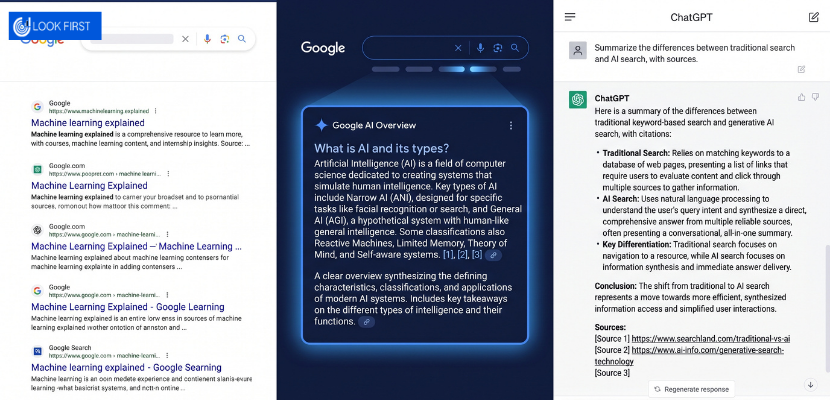
According to research, 58.5% of Google searches in 2024 received no clicks. When Google’s AI Mode is active, that figure jumps to 93%. Google’s AI Overviews now answer users’ questions before they see a single organic result, and Ahrefs found that when one appears, the click-through rate for the number-one-ranking page drops by 58%. At the same time, a growing segment of users has stopped going to Google altogether. ChatGPT processes 2.5 billion prompts daily; Perplexity, Gemini, and Copilot handle millions more, and, according to the 2026 report, 53% of UK adults now regularly see AI Overviews when they search. This is not a future concern; it is already happening, on every search your potential customers make today.
Visibility and traffic have become two separate things. You can rank on page one and still receive no clicks if an AI is giving the answer before a user reaches your result. This is where three disciplines have emerged to define modern digital marketing: SEO, AEO, and GEO. They are not competing approaches; they are interconnected layers of a visibility strategy every UK business needs to understand in 2026. This guide explains what each one is, how they differ, and what to do about it.
What Is SEO? And Why It Still Matters In 2026
Search Engine Optimisation is the practice of improving a website’s visibility in traditional search engine results pages, primarily on Google, which holds 91.47% of the UK search market share as of April 2026, according to Statcounter.
The fundamentals of SEO have not changed: keyword research, on-page optimisation, technical health, backlink authority, and content quality. See our complete SEO guide for the full framework. What has changed is the context in which SEO operates.
Organic search still drives 53% of all website traffic globally, according to the annual report. Google still processes an estimated 13.7 billion searches per day. The blue-link results page is not going away, and for transactional and commercial intent queries, where a user wants to buy something, compare providers, or request a quote, SEO-driven organic rankings still deliver strong click-through rates.
There is also a critical connection between SEO and the newer disciplines. Ahrefs found that 76% of AI Overview citations come from pages already ranking in the top ten organic results. This means that strong SEO is the upstream condition for AEO and GEO success. If your pages cannot rank, they are unlikely to be cited by AI systems either.
What SEO optimises for:
Rankings in Google’s traditional blue-link results.
How it is measured:
Keyword rankings, organic traffic, click-through rate, domain authority.
What it cannot do alone:
Get your brand cited in AI-generated answers, appear in ChatGPT responses, or earn visibility in voice search featured answers.
What Is AEO (Answer Engine Optimisation)?
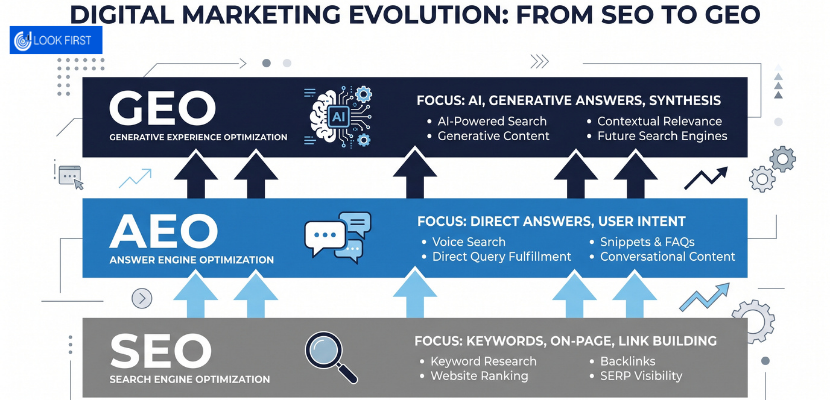
Answer Engine Optimisation is the practice of structuring your content so that it gets selected as the direct answer inside AI-generated results, specifically Google’s AI Overviews, featured snippets, People Also Ask boxes, and voice search responses.
AEO emerged from the shift toward zero-click search. As Google began answering questions directly on the results page through featured snippets and knowledge panels, it became clear that ranking in position one was no longer enough if someone else owned the answer box above it. AEO is the discipline of winning that answer box.
In 2026, the primary battleground for AEO is Google’s AI Overview. These AI-generated summaries now appear in roughly 16-60% of searches, depending on the query type, with the highest prevalence for informational, question-based queries. When an AI Overview appears and you are cited within it, data shows that your organic CTR increases by 35% compared to competitors who rank but are not cited.
How AEO Works
AEO is fundamentally about making your content easy for AI systems to extract and present as a direct, accurate answer. The selection process works like this: Google’s AI reads your content, evaluates whether it directly answers the query, assesses how clearly the answer is structured, and either pulls it into the AI Overview or passes to the next source.
Content that wins AEO citations tends to share several characteristics. It answers the question in the first one or two sentences of a section rather than building toward it over several paragraphs. It uses question-based headings that mirror the exact language a user would use in a search. It includes FAQ schema markup that helps Google identify question-and-answer pairs within the page. And it is written in plain, accessible language; AI systems surface content that can be read aloud without rewording.
Core AEO Tactics
Answer-first writing
Open every section with a concise 40-60 word direct answer before expanding
Question-based headings
Use H2 and H3 headers phrased as real user questions (“What is GEO?”, not “GEO Overview”)
FAQ schema markup
Implement FAQPage structured data so Google can identify your Q&A pairs
Concise definitions
Define every key term clearly and early; AI systems prioritise pages that define concepts precisely
Conversational language
Write the way users speak, particularly for voice search queries that trigger AEO results
AEO vs SEO: The Key Difference
The critical difference between AEO and SEO is what success looks like. SEO success is a click. AEO success is being the cited answer, which may or may not generate a click but still generates brand visibility and authority. As AI search grows, brand awareness through citation is becoming as valuable as traffic for many businesses, particularly in B2B and professional services.
What Is GEO (Generative Engine Optimisation)?
Generative Engine Optimisation is the practice of making your content, your brand, and your digital presence structured and authoritative enough that AI platforms, ChatGPT, Perplexity, Google Gemini, Microsoft Copilot, and Claude cite, reference, or recommend you when generating responses to user queries. For the full breakdown, see our dedicated guide on what GEO is and why businesses need it.
GEO is distinct from AEO in an important way. AEO is about winning a slot: Google extracts one featured snippet or one AI Overview answer, and you either own it or you do not. GEO is about being included in a synthesis. Generative AI models read dozens of sources and construct a single conversational answer from them. The goal is citation inclusion and mention frequency across multiple AI platforms, not a single position.
How GEO Works
AI platforms build their knowledge by crawling the web, training on large datasets, and in the case of real-time tools like Perplexity and Google AI Mode, running live searches at query time. When a user asks ChatGPT “which digital marketing agency should I use in London?”, the model synthesises information from multiple sources: its training data, web search results, third-party reviews, Reddit discussions, LinkedIn content, and authoritative industry directories.
Semrush’s 2025 research found that only about 50% of Google number-one rankings overlap with AI search citations. Half the pages ranking first on Google are invisible to AI platforms. The reason is that AI selection criteria differ from Google’s ranking factors. Backlinks, critical for Google rankings, have minimal direct impact on the probability of AI citations. Brand authority and entity recognition are the strongest AI citation signals.
The GEO research paper found that including citations, verifiable statistics, and quotations from recognised sources in content boosts AI citation frequency by over 40%. Structured content with clear definitions, comparison tables, and data-backed claims outperforms generic content regardless of domain authority.
| Factor | SEO | GEO |
|---|---|---|
| Primary Platform | Traditional Google (blue-link results) | AI-Powered ChatGPT, Perplexity, Gemini, AI Mode |
| Success Metric | Rankings + clicks | Citation inclusion + brand mentions |
| Key Ranking Signal | Backlinks + on-page optimisation | Brand authority + entity recognition |
| Content Format | Keyword-optimised long-form | Structured, cited, definition-rich |
| Traffic Model | Click-driven | Awareness-driven (with some referral) |
GEO vs AEO: The Distinction
In practice, AEO and GEO share significant tactical overlap; both favour structured content, direct answers, and authoritative sourcing. The distinction is platform-specific. AEO focuses on Google’s answer surfaces (AI Overviews, featured snippets, People Also Ask). GEO focuses on standalone generative AI platforms (ChatGPT, Perplexity, Gemini), where users go directly rather than searching Google first.
For most businesses, the same content improvements serve both disciplines simultaneously. The difference becomes relevant when prioritising: if your audience primarily uses Google, AEO is the immediate priority. If your audience, particularly B2B decision-makers, is increasingly going directly to ChatGPT or Perplexity, GEO deserves dedicated attention.
GEO vs SEO vs AEO: The Full Comparison
| Factor | SEO Search Engine Optimisation | AEO Answer Engine Optimisation | GEO Generative Engine Optimisation |
|---|---|---|---|
| What it optimises for |
Traditional Google rankings |
AI Answers Direct answers in AI features |
Generative Citations across generative AI platforms |
| Primary Platforms | Google, Bing | Google AI Overviews, voice assistants | ChatGPT, Perplexity, Gemini, Copilot |
| Goal | Drive clicks to your website | Own the answer box | Be cited in AI-generated responses |
| Key Tactics | Keywords, backlinks, technical SEO | FAQ schema, question headings, concise answers | Entity building, cited statistics, topical authority |
| Measured By | Rankings, organic traffic, CTR | Featured snippet ownership, AI Overview citations | Brand mentions in AI responses, citation rate |
| Works Without the Others? | Foundation — yes, but increasingly limited alone | Builds on SEO foundation | Requires SEO + AEO as base |
| Best For | Transactional / commercial queries | Informational / question queries | Research-stage and B2B discovery |
Which One Does Your Business Need, and Where Should You Start?
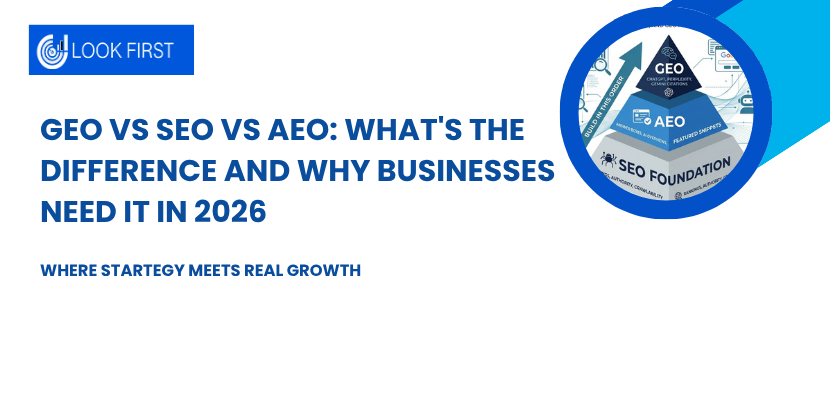
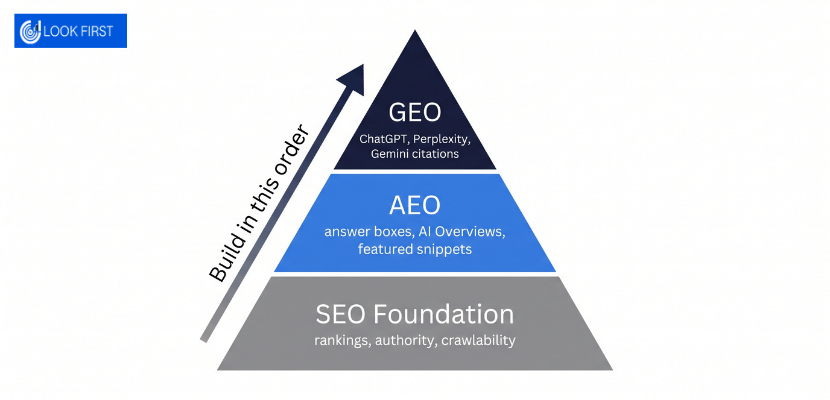
The good news is that you do not have to choose between SEO, AEO, and GEO. They build on each other in a clear sequence. The question is not which one to do; it is which order to prioritise them in, given your current position.
Step 1: Get Your SEO Foundation Right
No matter your industry, size, or market, SEO is the non-negotiable foundation. Ahrefs found that 76% of AI Overview citations come from pages already ranking in the top ten organically. AEO and GEO both depend on your content being crawlable, indexable, and authoritative enough for AI systems to trust. Without solid SEO underpinning, AEO and GEO strategies will have limited impact.
If your site has technical issues, thin content, or poor domain authority, fix those first. Every pound spent on GEO while your SEO foundation is weak yields diminishing returns.
Step 2: Layer In AEO
Once your SEO foundation is solid, AEO is the highest-impact next step for most UK businesses. Google AI Overviews now reach 2.5 billion people globally each month, and 53% of UK adults see them regularly. Winning a citation inside an AI Overview delivers a 35% CTR uplift even in a zero-click environment.
AEO improvements, FAQ schema, question-based headings, and answer-first writing, can be applied to existing content without creating new pages. The return on a content audit focused on AEO optimisation is typically faster than any other search marketing investment.
Step 3: Build GEO for Long-Term Visibility
GEO is a longer-term investment. It requires building brand entity recognition, earning third-party mentions across authoritative platforms, building topical authority through consistent expert content, and ensuring your digital presence is consistent and structured across the web, the same principles covered in our guide to AIO.
The businesses that are investing in GEO now are building a compounding advantage. Traffic from generative AI platforms grew approximately 796% year over year, and that trajectory is not slowing. The brands with an established AI citation presence in 2026 will have a significant head start when the volume of AI-initiated discovery doubles again.
Which Strategy by Business Type?
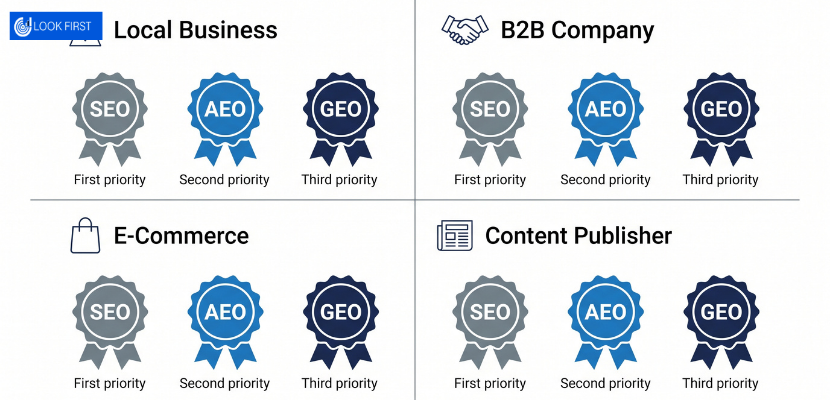
Local service businesses:
SEO and AEO are the priority. Local queries still generate clicks. Focus on Google Business Profile completeness, local SEO, and FAQ schema on service pages. GEO becomes relevant as Google AI Mode expands.
B2B companies and professional services
All three are immediately relevant. 68% of B2B decision-makers now initiate research using AI tools rather than traditional search engines. If your buyers use ChatGPT or Perplexity to evaluate options, GEO is not optional. Speak to a digital marketing agency in London that understands both traditional search and AI visibility before your competitors do.
E-commerce brands
SEO remains dominant; AI Overviews trigger on only 3-4% of e-commerce queries. Focus on product schema, review signals, and technical SEO. AEO for category-level informational content. GEO for brand positioning.
Content publishers and media
AEO and GEO are existential concerns. AI Overviews correlate with a 58% lower click-through rate for the top-ranking organic page. Publishers need to be cited inside AI Overviews, not bypassed by them.
Why Choose Look First Marketing For Your Business's Marketing Needs?
At Look First Marketing, we are a London-based digital marketing agency that has been helping businesses build search visibility for years. We were ahead of the AI search shift before most agencies had worked out what GEO stood for, and we have spent the last eighteen months building practical frameworks for clients across London and the UK to win visibility across traditional search, AI Overviews, and generative platforms simultaneously.
We offer SEO services in London that go beyond keyword rankings, AEO audits and implementations that get our clients cited in Google’s AI Overviews, and GEO Services in London that build the brand entity signals and content authority AI platforms use when deciding whose content to cite.
If 65% of marketers say AI-driven search changes are their number-one challenge in 2026, and 73% of businesses are currently invisible in AI search, the businesses that invest in getting this right now will have a significant advantage over those that are still figuring it out in twelve months.
Conclusion:
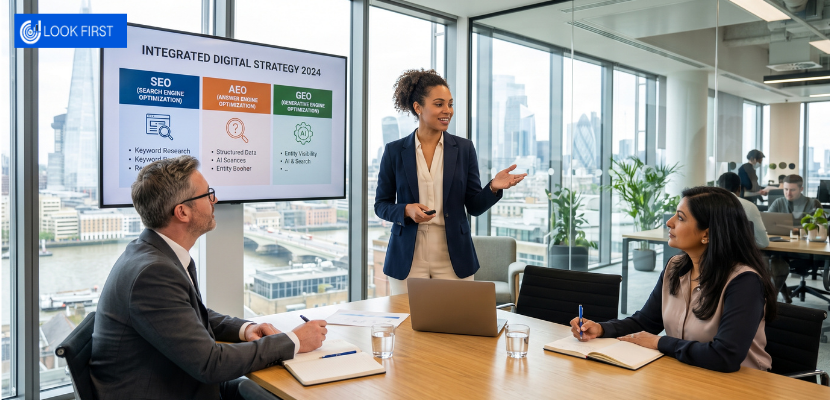
SEO, AEO, and GEO are not three competing options. They are three interconnected layers of what it means to be visible online in 2026. SEO remains the foundation; without it, neither AEO nor GEO strategies will reach their potential. AEO is the highest-ROI next step for most businesses, turning your best content into cited answers inside Google’s AI features. GEO is the longer-term investment that ensures your brand is named and recommended inside the AI platforms where a growing share of discovery is happening.
The businesses that treat these three disciplines as a single, joined-up strategy will build compounding visibility advantages over the next two to three years. The ones that do not will find their organic traffic declining even as their rankings hold, because the game has changed beneath them.
If you are ready to understand exactly where your business stands across SEO, AEO, and GEO, and what to prioritise first, get in touch with Look First Marketing for a free, no-obligation consultation.
FAQS
SEO (Search Engine Optimisation) focuses on ranking in Google’s traditional blue-link results to drive clicks. AEO (Answer Engine Optimisation) structures content to appear as the direct answer inside Google’s AI Overviews, featured snippets, and voice search responses. GEO (Generative Engine Optimisation) goes further: it optimises your brand and content to be cited and recommended by standalone AI platforms such as ChatGPT, Perplexity, and Gemini. All three work together as layers of a modern visibility strategy.
Yes, SEO remains the foundation of all digital visibility. Ahrefs found that 76% of Google AI Overview citations come from pages already ranking in the top ten organically. Without strong SEO underpinning your content, AEO and GEO strategies will have limited impact. Organic search also still drives 53% of all website traffic globally. What has changed is that SEO alone is no longer sufficient; AEO and GEO are essential additions, not replacements.
GEO stands for Generative Engine Optimisation. It is the practice of structuring your content, brand signals, and digital presence so that AI-powered platforms, including ChatGPT, Google Gemini, Perplexity, and Microsoft Copilot, cite, reference, or recommend your business when generating answers to user queries. Unlike traditional SEO, GEO success is measured not by rankings or clicks but by citation inclusion and the frequency of brand mentions across AI platforms.
Start with your SEO foundation; ensure your site is technically healthy, fully crawlable by AI bots, and has solid content authority. Then apply AEO improvements to your most important pages: add question-based headings, open sections with direct answers, implement FAQ schema markup, and restructure content so answers appear immediately rather than after several paragraphs. GEO is a longer-term program requiring entity building, third-party mentions, verifiable statistics in content, and consistent brand signals across the web.
Yes, and urgently. A report found that 53% of UK adults now regularly see AI Overviews when they search on Google. AI traffic to websites grew 796% year over year. And 73% of businesses are currently invisible in AI search, giving those that act now a significant first-mover advantage. UK businesses, particularly in professional services, B2B, and competitive local markets, need to be actively optimising for AEO and GEO now rather than waiting until the shift is complete.