
What Is Social Media Marketing? A Complete Guide For Beginners
Social media marketing is the process of using platforms like Instagram, Facebook, LinkedIn, TikTok, and YouTube to promote a business, engage an audience, and drive sales through organic content and paid advertising. It delivers an average return of £4 for every £1 spent when managed effectively, and over 5.66 billion people, more than two-thirds of the global population, now use social media.
Social media marketing has become one of the most powerful tools available to businesses of all sizes. Whether you are a sole trader just starting or an established company looking to grow your online presence, understanding how it works is no longer optional. It is a fundamental part of running a successful business in 2026.
What Is Social Media Marketing?
Social media marketing is the process of using social media platforms, such as Instagram, Facebook, LinkedIn, TikTok, and YouTube, to promote your business, connect with your audience, and achieve your marketing goals.
It involves creating and sharing content, engaging with followers, running paid advertisements, and building a consistent brand presence across the platforms where your customers spend their time.
Unlike traditional advertising, such as print, radio, or television, social media marketing allows businesses to have direct, two-way conversations with their audience. A customer can comment on your post, share your content with their network, send you a message, or leave a review, all in real time. This level of interaction was simply not possible with older forms of marketing.
At its core, social media marketing is about three things: visibility, connection, and conversion. Getting your business seen by the right people, building relationships with them over time, and ultimately turning those relationships into customers and revenue.
Why Social Media Marketing Matters In 2026
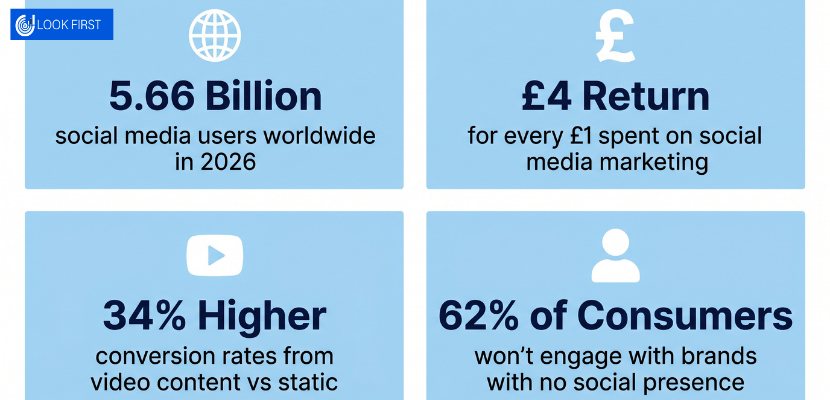
The scale of social media today is difficult to overstate. As of 2026, over 5.66 billion people use social media worldwide, more than two-thirds of the global population. (DataReportal, 2026). These are not passive users. They are actively discovering products, researching businesses, reading reviews, and making purchasing decisions directly on social platforms.
The business case is equally compelling:
- Social media marketing delivers an average return of £4 for every £1 spent when managed effectively.
- Video-based campaigns generate 34% higher conversion rates than static content across all platforms.
- 62% of consumers say they will not engage with a company that has no social media presence.
- 91% of executives plan to increase their social media budget in 2026.
For businesses in competitive markets like London, this is particularly significant. Any experienced digital marketing agency in London will tell you that social media is now one of the first channels they build their strategy around; our guide to digital marketing strategies for London businesses covers exactly how it fits with the rest, because that is where your customers already are and where your competitors show up every day.
How Does Social Media Marketing Work?
Social media marketing works by consistently showing up in front of your target audience with content that is relevant, valuable, and engaging, on the platforms they already use.
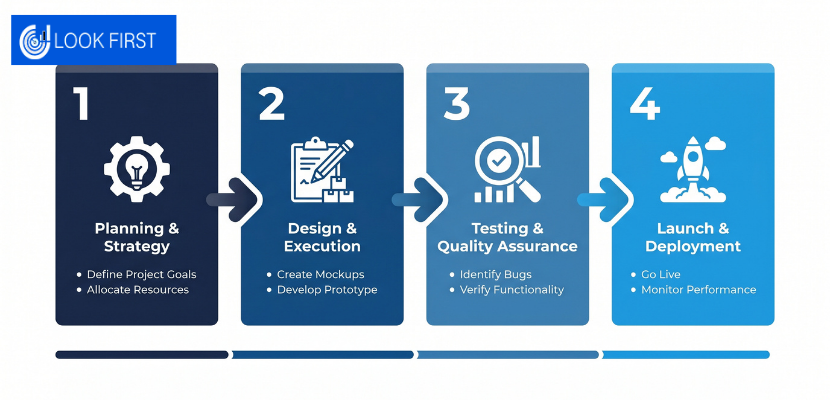
The process follows four key stages:
1. Strategy
Before posting anything, define your audience, the platforms they use, the types of content that will resonate with them, and the business goals you are trying to achieve. A strategy should cover your target audience profile, content pillars, posting frequency, and how you will measure success. Without a strategy, social media activity becomes random and produces inconsistent results, which is exactly why digital marketing experts always recommend building a clear plan before posting anything.
2. Content Creation
This is the practical work of producing posts, images, videos, stories, reels, and carousels that your audience will find useful or interesting. Good content educates, entertains, or solves a problem. It gives people a reason to follow your account, engage with your posts, and remember your business. The format matters as much as the message. A well-produced Reel will consistently outperform a static image in terms of reach on most platforms in 2026.
3. Publishing and Engagement
Consistent posting builds momentum over time. Algorithms on every major platform reward accounts that show up regularly and generate genuine interaction. Engagement, responding to comments, answering messages, and interacting with other accounts, signals to the platform that your content is worth showing to more people. Businesses that post but never respond to their audience miss the channel’s most valuable part entirely.
4. Analysis and Optimisation
Social media marketing is not a set-and-forget activity. Reviewing performance data regularly, what content performed well, which posts drove traffic or enquiries, and what your audience responded to, allows you to refine your approach and improve results over time. The businesses seeing the strongest growth are those that treat social media as a system to be tested and improved, not just a broadcast channel.
The Key Benefits of Social Media Marketing For Businesses
Increased Brand Awareness
Social media puts your business in front of people who may never have found you otherwise. Consistent, quality content builds recognition over time, so that when someone needs your product or service, your business comes to mind first.
Direct Access to Your Audience
No other marketing channel gives you the ability to communicate directly with your customers as easily as social media. You can answer questions, gather feedback, handle complaints, and celebrate your customers, all publicly, in real time.
Cost-Effective Marketing
Creating a social media profile and posting content is free. Even paid social advertising can be started with a modest budget and scaled as results improve. For small businesses in particular, social media offers reach and targeting that traditional advertising simply cannot match at the same cost.
Drives Traffic to Your Website
Every piece of content you publish on social media is an opportunity to direct people to your website, whether to read a blog post, learn about a service, or make a purchase. Social media and SEO work together to build your overall online visibility, see our complete SEO guide for how the two connect.
Builds Trust and Credibility
A well-maintained social media presence with genuine engagement, real customer reviews, and consistent content signals to potential customers that your business is legitimate, active, and trustworthy. In markets like London, where competition is intense, that trust is a genuine competitive advantage.
Need help building a social media strategy that actually delivers results? See how we help London businesses grow online.
Which Social Media Platform Is Right for Your Business?
Not every platform suits every business. Choosing the right one or two platforms and doing them well is far more effective than spreading yourself thin across five.Facebook
Still the largest social media platform globally, with over 3 billion monthly active users. Best for local businesses, service companies, and anyone targeting adults aged 25 to 55. Facebook’s paid advertising tools offer some of the most precise audience targeting available in digital marketing.Instagram
Ideal for visually-led businesses, restaurants, retail, interior design, fashion, fitness, and hospitality. Instagram Reels consistently deliver the highest organic reach of any content format on the platform. Best for audiences aged 18 to 44.LinkedIn
The most powerful platform for B2B marketing and professional services. LinkedIn lead generation ads average a 6.1% conversion rate, higher than almost any other digital channel. Essential for agencies, consultancies, recruiters, and any business selling to other businesses.
TikTok
The fastest-growing platform in the world, now with over 1.5 billion monthly active users. Best for brands targeting audiences under 35 with entertaining, authentic short-form video content. Organic reach on TikTok remains significantly higher than on Facebook or Instagram.YouTube
The world’s second-largest search engine. Best for long-form educational content, tutorials, product demonstrations, and any business where video builds trust, legal, financial, home services, and healthcare in particular. YouTube content also benefits SEO directly.| Platform | Best For | Primary Age Group | Content Type |
|---|---|---|---|
| Local & service businesses | 25-55 | Posts, ads, video | |
| Visual & lifestyle brands | 18-44 | Reels, stories, carousels | |
| B2B & professional services | 25-54 | Articles, posts, ads | |
| TikTok | Consumer brands, youth market | 16-34 | Short-form video |
| YouTube | Education & trust-building | All ages | Long-form video |
Types of Social Media Content That Perform Best In 2026
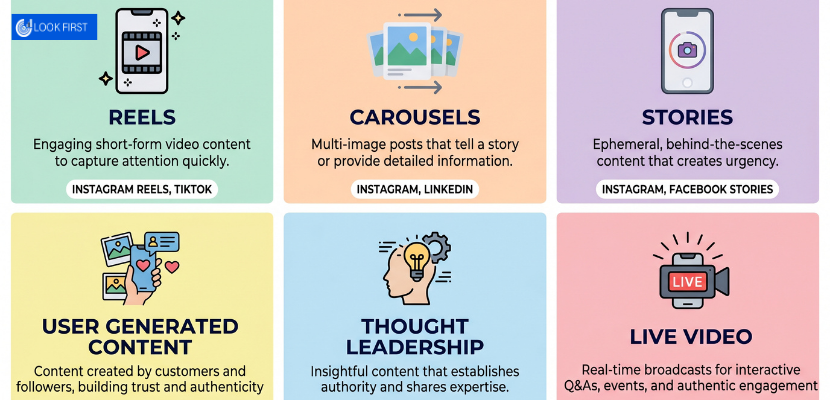
Reels and Short-Form Video
The highest-reach content format on both Instagram and Facebook. Short, engaging videos between 15 and 60 seconds consistently outperform static posts for organic reach and engagement.
Carousels
Multi-image posts on Instagram and LinkedIn that encourage swiping. Carousels generate significantly more saves and shares than single-image posts, making them ideal for educational content, tips, and case studies.
Stories
Temporary content on Instagram and Facebook that creates urgency and drives direct interaction through polls, questions, and swipe-up links. Best for behind-the-scenes content and time-sensitive offers.
User-Generated Content (UGC)
Content created by your customers featuring your product or service. UGC builds trust faster than branded content and costs nothing to produce. Encouraging and resharing customer posts is one of the highest-ROI social media activities available.
Educational Posts and Thought Leadership
Content that answers your audience’s questions or shares genuine expertise. Performs exceptionally well on LinkedIn and is increasingly performing well on Instagram. Positions your business as the go-to authority in your field.
Live Video
Live broadcasts on Instagram, Facebook, and LinkedIn generate three times as much engagement as pre-recorded videos, on average. Best for Q&As, product launches, and behind-the-scenes events.
Organic vs Paid Social Media Marketing
Understanding the difference between organic and paid social media is essential for building an effective strategy.
Organic social media is content posted to your profile that reaches your existing followers and anyone who discovers it through shares or the platform algorithm. It costs nothing but time and builds long-term brand presence, trust, and community.
Paid social media is advertising, content you pay to show to a targeted audience you define, including people who have never heard of your business. It delivers immediate reach and precise targeting but requires an ongoing budget.
| Factor | Organic Social | Paid Social |
|---|---|---|
| Cost | Free | Ongoing budget required |
| Reach | Existing followers + algorithm | Targeted audience you define |
| Speed | Builds gradually | Immediate |
| Best For | Brand building, community, trust | Lead generation, promotions, reach |
| Longevity | Content stays live | Stops when budget runs out |
The most effective social media strategies use both organic content, which builds trust and community over time, and paid advertising, which accelerates reach and drives specific actions like enquiries, sign-ups, or sales.
How Social Media Algorithms Work
Every major social media platform uses an algorithm to decide which content to show, to whom, and how often. Understanding how algorithms work is one of the most important things a business can do to improve its organic reach without spending anything on advertising.
Algorithms reward content that generates genuine engagement quickly after posting, likes, comments, shares, and saves. They favour accounts that post consistently and use the platform’s native features, particularly newer formats like Reels and Stories. They penalise content that drives people away from the platform, such as posts with external links in the caption on Instagram or Facebook.
The practical takeaway is this: post consistently, use video and native formats wherever possible, respond to every comment and message, and avoid posting links in captions unless the platform supports them. Consistency and genuine engagement will always outperform irregular bursts of posting. Learn exactly how to put this into practice in our guide on how to market your business on social media.
Essential Social Media Marketing Tools
Meta Business Suite
Free tool from Meta for managing Facebook and Instagram in one place. Scheduling, analytics, inbox management, and ad creation all in one dashboard.
Buffer
Scheduling and analytics platform supporting all major platforms. Clean interface, ideal for small businesses managing their own social media.
Hootsuite
Enterprise-level social media management covering scheduling, monitoring, team collaboration, and detailed analytics across all platforms.
Later
Visual content calendar and scheduling tool, particularly strong for Instagram planning. Drag-and-drop interface makes content planning fast and intuitive.
Canva
Graphic design tool with social media templates for every platform and format. Used by millions of businesses to produce professional-quality content without a designer.
Book a free consultation with Look First Marketing and take the first step towards a stronger social media presence.
Common Social Media Marketing Mistakes to Avoid
Posting without a strategy
Random posting produces random results. Every piece of content should serve a purpose that connects back to a clear business goal.
Ignoring engagement
Social media is a two-way channel. Businesses that post but never respond to comments or messages miss the platform’s most valuable part entirely.
Trying to be everywhere
Focus on doing two platforms well rather than doing five platforms poorly. Quality and consistency always outperform quantity.
Deleting negative comments
Responding professionally to criticism builds far more trust than removing it. How a business handles a complaint publicly says a great deal about how it treats customers privately.
Measuring the wrong things
Follower count and likes are vanity metrics. What actually matters is website traffic, enquiries, and revenue generated from social media activity.
Getting Started With Social Media Marketing
If you are new to social media marketing, the most important thing is to start simply and build from there.
Begin by identifying where your target audience spends their time. If you are unsure, start with Facebook and Instagram; they cover the broadest demographic range and are where most UK businesses see the strongest early results.
Set up a complete, professional business profile on your chosen platforms. Use a consistent logo, a clear business description, and accurate contact details across all platforms.
Commit to a realistic posting schedule. Three high-quality posts per week on one platform will produce better results than daily posts across five platforms that are rushed or inconsistent.
Focus your content on providing genuine value, answering your customers’ questions, showing the human side of your business, and demonstrating your expertise. Content that educates, entertains, or solves a problem will always outperform content that simply sells.
Review your performance monthly. Look at which posts drove the most engagement, reach, and website visits, and do more of what is working.
Working With a Social Media Agency
At Look First Marketing, we are a social media marketing agency in London helping businesses build a genuine, results-driven presence across all major platforms. From strategy and content creation to community management and paid advertising, our team handles everything so you can focus on running your business.
Explore our Social Media Marketing services and see exactly how we can help your business grow.
Conclusion:
Social media marketing is not complicated in principle, but it does require consistency, strategy, and a genuine understanding of your audience. Done well, it builds brand awareness, drives website traffic, generates enquiries, and creates lasting relationships with your customers.
The businesses seeing the strongest results from social media in 2026 are not necessarily the ones with the biggest budgets. They are the ones consistently showing up, creating content their audience actually finds useful, and engaging authentically with their followers.
Whether you are managing social media yourself or working with a digital marketing specialist, the fundamentals remain the same: know your audience, choose the right platforms, create content that adds value, and measure what matters.
FAQS
Consistency matters more than frequency. For most small businesses, posting three to five times per week on your primary platform is a realistic and effective starting point. One well-crafted post that genuinely helps your audience will always outperform five rushed posts that add no value.
No. Creating a profile and posting organic content on any social media platform is completely free. Even paid social advertising can be started with as little as £5-£10 per day on Facebook or Instagram and scaled gradually as you see results.
Organic social media typically takes three to six months of consistent effort before you start seeing meaningful growth in followers, engagement, and website traffic. Paid social advertising can produce results much faster, sometimes within days of launching a campaign.
Not exactly. While the core message can remain the same, the format and tone should be adapted for each platform. A long-form professional article works well on LinkedIn but would feel out of place on Instagram. Always tailor the format to fit where it is being published.
A social media post is organic content published to your profile and visible primarily to your existing followers. A social media ad is paid content shown to a targeted audience you define, including people who have never heard of your business.
Yes, indirectly. AI tools like ChatGPT and Google AI Overviews often factor in brand mentions, engagement, and reviews from social platforms when deciding which businesses to recommend, so an active, well-engaged social presence supports visibility in AI-generated answers too.
Facebook and Instagram typically give small businesses the best early ROI, since they cover the broadest demographic range and support both free organic content and low-cost paid ads starting from £5–£10 per day.