
What Is E-E-A-T In SEO? A Simple 2026 Guide
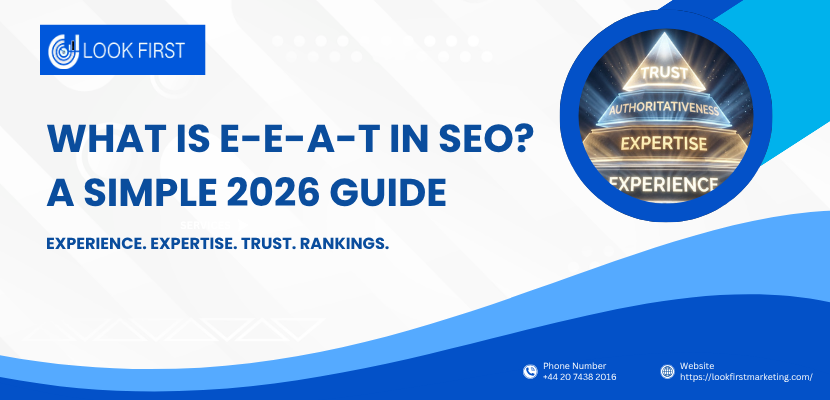
E-E-A-T stands for Experience, Expertise, Authoritativeness, and Trustworthines, the framework Google uses to judge whether content is credible enough to rank. It isn’t a direct ranking score; it’s a set of signals (author credibility, real experience, backlinks, trust indicators) that shapes how both Google and AI search tools like ChatGPT and AI Overviews decide what to cite.
The businesses outranking you are not working harder; they are being evaluated differently. And once you understand how, everything starts to make sense. That is the E-E-A-T framework, and after the December 2025 Core Update, it now applies to virtually every competitive search category: not just health and finance, but also e-commerce, local services, how-to guides, SaaS comparisons, and more. Whether you run a local restaurant, a law firm, or an e-commerce store, the same rules now apply.
If you are a business owner in London or anywhere in the world trying to improve your Google rankings, this guide will give you the clearest, most up-to-date picture of E-E-A-T in 2026, and exactly what you need to do about it.
What Is E-E-A-T? The Simple Definition
E-E-A-T stands for Experience, Expertise, Authoritativeness, and Trustworthiness. It is the framework Google uses to evaluate whether your content is genuinely helpful, credible, and worth showing to users.It comes directly from Google’s Search Quality Rater Guidelines, a detailed handbook used by thousands of real human reviewers to assess the quality of web pages. These reviewers do not directly set rankings, but their feedback helps train and improve Google’s algorithms over time.Think of it this way: if you needed medical advice, you would want it from someone who has actually treated patients (Experience), holds a medical degree (Expertise), is recognised by other doctors (Authoritativeness), and runs a legitimate, verifiable practice (Trustworthiness). That is exactly how Google thinks about every website it ranks.
E-E-A-T is NOT a direct ranking factor with a measurable score you can see in Google Search Console. There is no ‘E-E-A-T meter’. It is a framework that shapes how Google’s algorithms identify and reward genuinely helpful, credible content, and how they penalise content that merely looks helpful but is not.
| E-E-A-T Pillar | What It Means |
|---|---|
| Experience | Has the content creator personally done, used, or lived through what they are writing about? |
| Expertise | Does the creator have deep knowledge, skills, or qualifications in this subject area? |
| Authoritativeness | Is the website or author recognised and cited by others as a credible source in their field? |
| Trustworthiness | Is the website accurate, transparent, secure, and honest? Is it safe for users? |

From E-A-T to E-E-A-T: A Quick History
Google first introduced the concept as E-A-T (Expertise, Authoritativeness, Trustworthiness) in its Search Quality Rater Guidelines in 2014. For years, it was particularly relevant to YMYL (Your Money or Your Life) websites and to medical, legal, and financial content.
In December 2022, Google added a second ‘E’, Experience, making it E-E-A-T. This was a deliberate response to a specific problem: the explosion of AI-generated and recycled content that sounded expert but was written by systems or people with zero real-world experience on the topic.
| Then (E-A-T, 2014–2022) | Now (E-E-A-T, 2022–2026) |
|---|---|
| Focused mainly on YMYL industries | Applies to virtually all competitive searches |
| Experience not formally recognised | First-hand experience is now an explicit, valued signal |
| Author credentials were helpful | Named, verifiable authors are now essential |
| AI content was uncommon | Google’s systems actively detect generic, experience-free AI content |
| Trust signals were basic (HTTPS, about page) | Trust is now the single most important E-E-A-T pillar |

The Four Pillars of E-E-A-T - Explained With Real Examples
Pillar 1: Experience – The Signal That Changed Everything
Experience is the newest, and arguably most important, addition to the framework. It asks a simple question: has the person writing this content actually done the thing they are writing about?
This is the signal that separates a genuine restaurant review (written by someone who ate there) from a scraped summary (produced by someone who never visited). It is what distinguishes a plumber’s guide to fixing a boiler (written from years of callouts) from a generic article written by someone who simply read other guides.
For your website, experience signals include:
- Personal stories, anecdotes, or lessons learned from real situations
- Original photos, videos, or before-and-after documentation of actual work
- Case studies featuring real clients, real problems, and measurable outcomes
- Specific details, dates, tools, locations, and methods that only a practitioner would know
- Product or service reviews based on genuine personal use
Example:
A digital marketing agency in London writing about ‘how to improve local SEO for a restaurant’ carries far more E-E-A-T weight if it includes a real case study that shows a specific London client’s Google Business Profile before and after their campaign, with actual ranking improvements and booking increases. Generic advice without evidence of real work carries very little Experience signal.
Pillar 2: Expertise – Show Google You Truly Know Your Field
Expertise focuses on the depth of knowledge demonstrated in your content. Google recognises two valid types:
• Formal expertise:
Verified qualifications and professional credentials, a solicitor writing about
employment law, a chartered accountant writing about UK tax relief, a registered nurse writing about medication dosages.
• Everyday expertise:
Deep knowledge gained through years of hands-on experience, a master chef
writing about French cooking techniques, a seasoned property developer writing
about planning permission in London.
What expertise is NOT:
Rewriting someone else’s blog post, producing generic AI summaries, or publishing content on topics far outside your actual knowledge base.
Expertise signals Google looks for on your website:
- Named author bios with qualifications, years of experience, and areas of specialism
- In-depth content that goes well beyond surface-level information
- Citing credible, up-to-date sources, government sites, industry publications, peer-reviewed research
- Author profiles linked to LinkedIn, professional portfolios, or published external work
- Schema markup (Article, Person) that makes your author credentials machine-readable for Google
Pillar 3: Authoritativeness – Reputation That Others Confirm
Authority cannot be self-declared. You cannot simply write on your About page that you are a leading expert; Google looks for external confirmation. Who links to you? Who cites you? Who mentions your brand without being asked?
Key authority signals in 2026:
- High-quality backlinks from topically relevant, credible websites
- Brand mentions across the web, even without a direct hyperlink (Google can detect these)
- Coverage and expert quotes in industry publications, trade journals, and news outlets
- Guest articles or expert contributions on well-regarded external websites
- Positive, genuine reviews on Google Business Profile, Trustpilot, and sector-specific platforms
- Speaking at conferences, appearing on podcasts, or contributing to webinars
- Your content being cited by others as a primary source, especially original research or data
London Business Tip
Getting featured in London-specific publications, such as Business Reporter, London Business News, or your industry’s UK trade journal, sends powerful dual signals: it builds topical authority for E-E-A-T AND strengthens your local SEO by associating your brand with London-specific entities. These are not vanity metrics; they are authority signals that Google’s systems are actively looking for.
Pillar 4: Trustworthiness – The Most Critical E-E-A-T Signal
According to Google’s own Search Quality Rater Guidelines, Trust is the most important element of the entire E-E-A-T framework. The other three pillars, Experience, Expertise, and Authority, all feed into and support Trustworthiness. A website can have all three and still fail if trust signals are missing or broken.
Trust signals Google evaluates:
- HTTPS / SSL certificate, your site must be secure.
- Clear, accurate contact information, phone number, email address, and physical address.
- Transparent About Us page explaining who you are, what you do, and who is behind the content.
- Privacy Policy, Cookie Policy, and Terms of Service pages.
- Honest, factually accurate content, no misleading claims or deceptive language.
- Clear authorship: Every piece of content should have a named, credible author.
- Return and refund policies for e-commerce websites.
- Genuine, verified third-party reviews, not fake or incentivised.
- No deceptive design patterns, confusing pop-ups, or misleading calls to action.
- Accessibility: your site should work for all users.
A professionally built site through expert web development services ensures all these trust signals are structurally sound from day one.
The December 2025 Core Update: How E-E-A-T Standards Changed

Google’s December 2025 Core Update was one of the most significant algorithm updates in recent years, and E-E-A-T was at the heart of it.
Before this update, many businesses assumed E-E-A-T only mattered for YMYL (Your Money or Your Life) categories, health, finance, and legal. After December 2025, that assumption is definitely wrong.
| Before December 2025 | After December 2025 |
|---|---|
| E-E-A-T is mainly critical for health, finance, and legal | E-E-A-T now applies to e-commerce, SaaS, reviews, how-tos, and local services |
| AI-generated content seen as an emerging concern | Google’s systems are now significantly better at detecting generic, experience-free AI content |
| Author bios were a best practice | Named, verifiable authors are now close to essential for competitive searches |
| Review quantity mattered most | Review freshness and response rate are now factors in trust signals |
| Domain authority was the primary authority signal | Entity recognition, your brand as a known entity, now carries significant weight |
The practical impact: websites that relied on anonymous content, thin AI-generated articles, or outdated information saw significant drops in rankings after December 2025. Websites with strong author identities, original content, and genuine industry reputation held firm or improved.
E-E-A-T and AI Search in 2026: The New Frontier
This is the section most E-E-A-T guides completely miss, and it is one of the most important developments of 2026.
Google AI Overviews now appear at the top of search results for millions of queries, generating direct answers without requiring users to click through to any website. Similarly, AI platforms like ChatGPT Search, Perplexity, and Microsoft Copilot are synthesising answers from across the web.
Here is the critical insight: these AI systems heavily rely on E-E-A-T signals to decide which sources to cite and trust. They scrape, synthesise, and reference content primarily from websites that demonstrate strong Experience, Expertise, Authority, and Trust. Low-E-E-A-T websites are effectively invisible in AI-generated answers.
E-E-A-T and Entity SEO: The Connection Most Businesses Miss
In 2026, Google is not just evaluating individual web pages; it is building a picture of entities: real-world things like people, businesses, organisations, and concepts that Google recognises and understands.
When Google knows that your business is a real, verifiable entity, with a consistent name, address, phone number, industry, team members, and online presence, it applies that entity-level trust across everything you publish. This is called Entity SEO, and it works in direct partnership with E-E-A-T.
How to build your business as a recognised entity:
- Ensure your business name, address, and phone number are perfectly consistent everywhere online
- Create and maintain a Wikipedia or Wikidata entry if your business qualifies
- Use Organisation Schema markup on your website with complete, accurate information
- Have your key team members build their own author entities, LinkedIn profiles, published work, speaking bios
- Get your brand mentioned consistently across the web, not just linked to, but named
- Submit your business to Google’s Knowledge Panel through Google Search Console
12 Proven Strategies to Build Your E-E-A-T in 2026

Strategy 1: Build Comprehensive, Verifiable Author Profiles
Every piece of content on your website needs a named, real author with a detailed bio. Include full name, professional credentials, years of experience, specialist areas, LinkedIn profile link, and links to other published work. Add Person Schema markup to make this information machine-readable for Google.
The ‘Anonymous Admin’ approach is actively harming your rankings. Google builds author entities, and it cross-references author names across the web. The more visible and credible your authors are outside your website, the stronger your expertise signal becomes.
Strategy 2: Publish Genuine Case Studies With Real Results
Nothing demonstrates Experience more powerfully than a detailed, verifiable case study. Show the client (with permission) the challenge, your approach, the timeline, and the measurable results. Use real numbers. Include real screenshots. Add real testimonials from real people. You can see examples of this on our website at lookfirstmarketing.com: real clients, real numbers, real results.
Strategy 3: Create Original Research and Data
Original research makes you a primary source. When other websites cite ‘According to Look First Marketing’s 2026 London SEO Survey…’, that is one of the most powerful authority-building moves available to you. Conduct surveys among your clients, compile industry data, or analyse your own campaign results into a publishable report.
Strategy 4: Earn High-Quality, Topically Relevant Backlinks
Focus on quality over quantity. One backlink from a respected UK marketing publication is worth more than 200 links from generic directories. If you are looking for professional SEO services, prioritising authority over volume is the first thing any credible agency will tell you. Invest in digital PR, pitch expert commentary to journalists, contribute to industry roundups, and write guest articles for authoritative blogs in your space.
Strategy 5: Optimise Your Google Business Profile Consistently
Treat your GBP as a living, active extension of your website. Post weekly updates, respond to every review within 24 hours, add fresh photos monthly, keep your hours and services accurate, and respond to every review promptly and professionally. GBP activity is a direct local E-E-A-T signal.
Strategy 6: Build a Strong, Genuine Review Profile
Actively ask satisfied clients to leave detailed reviews on Google, Trustpilot, and any relevant industry platforms. A study found that 97% of UK consumers read online reviews of local businesses, and 74% consider only reviews from the last three months. Freshness matters as much as volume.
Strategy 7: Implement Schema Markup Across Your Site
Schema markup tells Google explicitly what your content is about and who is behind it. Implement Article schema (with author details), Organisation schema (business name, address, contact), Person schema (for key team members), and FAQ schema (for question-and-answer content). Most competitors skip this; it is a genuine competitive advantage.
Strategy 8: Keep Content Accurate and Regularly Updated
Outdated content is a trust signal problem. Schedule quarterly content audits. Update statistics, refresh examples, add ‘Last Reviewed’ dates to important articles, and remove or redirect pages that are no longer accurate. After the December 2025 update, content freshness is more important than ever.
Strategy 9: Establish Your Team as Industry Thought Leaders
Appear on UK business podcasts. Speak at marketing events. Contribute expert quotes to industry articles. Get your team members active on LinkedIn with regular, insightful posts. Every external appearance builds a richer author entity and strengthens your business’s overall authority profile.
Strategy 10: Strengthen Technical Trust Signals
Ensure your website has HTTPS. Pass Core Web Vitals (fast load times, visual stability, responsiveness). Have a clear, easy-to-find Privacy Policy. Make your contact information visible on every page. These are the baseline; without them, your content-level E-E-A-T signals are undermined.
Strategy 11: Use AI Tools Correctly – Not as a Replacement for Expertise
Google does not penalise AI-assisted content. It penalises low-quality, generic, experience-free content. Use AI tools to draft, structure, and research, then ensure every piece of content is reviewed, enhanced, and validated by a human expert with genuine experience in the topic. The AI drafts. The expert elevates. That is the right workflow in 2026.
Strategy 12: Build Content Clusters Around Your Core Topics
Instead of isolated blog posts, build topic clusters: a comprehensive pillar page on a core subject (like this one) surrounded by related, in-depth supporting articles, all internally linked. This signals to Google that your website has consistent, deep expertise on a topic, not just occasional surface-level coverage. It is one of the most powerful long-term E-E-A-T and ranking strategies available.
10 Common E-E-A-T Mistakes That Are Hurting UK Businesses
Most of these mistakes come from treating E-E-A-T as separate from core SEO work, when in reality it touches every type of SEO your business runs. Our guide to the different types of SEO shows exactly where trust and authority signals fit into on-page, technical, and off-page SEO.
| Mistake | How to Fix It |
|---|---|
| Publishing content under ‘Admin’ or with no author name | Every page needs a named, credible, real author with a full bio |
| Copying or paraphrasing competitor content | Create original content rooted in your own real experience and expertise |
| A bare or outdated About Us page | Write a detailed About page, who you are, your story, your team, and why you are qualified |
| Ignoring or not responding to reviews | Actively collect reviews and respond to every single one within 24 hours |
| No HTTPS or missing trust pages | Add SSL, Privacy Policy, Cookie Policy, and clear contact information |
| Publishing pure AI content with no human review | Always add genuine human expertise, experience, and editorial review to AI-assisted drafts |
| Chasing backlink quantity over quality | Focus exclusively on relevant, authoritative sources; even a handful of quality links beats hundreds of weak ones |
| No Schema markup for authors or organisation | Implement Article, Person, and Organisation Schema across your entire site |
| Assuming E-E-A-T only matters for YMYL niches | After December 2025, E-E-A-T applies to virtually all competitive search categories |
| Not building your authors’ external profiles | LinkedIn, published articles, podcast appearances, and reputable entities outside your own website |
Your E-E-A-T Audit Checklist for 2026
Work through this checklist to identify exactly where your website’s E-E-A-T is strongest and where it needs work:
Experience Signals
- Content includes first-person stories, personal anecdotes, or direct observations
- Original photos, screenshots, or videos demonstrating real work
- Case studies with named clients, real challenges, and measurable results
- Product and service reviews reflect genuine first-hand use
- Specific, practitioner-level details that generic content would not include
Expertise Signals
- Every article or page has a named author with a detailed, linked bio
- Author qualifications, credentials, or years of relevant experience are stated
- Content depth clearly exceeds what a casual researcher could produce
- Credible, up-to-date external sources are cited
- Person Schema and Article Schema are implemented on content pages
Authoritativeness Signals
- Backlinks from topically relevant, reputable UK and industry websites
- Brand mentioned in industry publications or news outlets
- Google Business Profile fully completed and regularly updated
- Strong, genuine review profile on Google, Trustpilot, or sector-specific platforms
- Team members active and visible on LinkedIn and in industry communities
Trustworthiness Signals
- Website secured with HTTPS
- Clear contact details (phone, email, address) visible on every page
- Detailed About Us page with real team information
- Privacy Policy, Cookie Policy, and Terms of Service pages in place
- Content is factually accurate and has been recently reviewed
- No deceptive design patterns or misleading claims anywhere on the site

Conclusion:
E-E-A-T cannot be faked with keywords or clever SEO tricks. At its core, Google simply wants to know whether your website provides genuinely useful, trustworthy, and credible information. The businesses succeeding in search in 2026 are the ones demonstrating real experience, expertise, authority, and trust across their content and websites.
If you want to strengthen your rankings, visibility, and credibility online, Look First Marketing can help with strategic SEO, content optimisation, authority-building, and technical trust improvements.
Ready to build your E-E-A-T the right way? Contact Us today!
FAQS
No, Google has confirmed there is no single E-E-A-T score. However, the signals that demonstrate strong E-E-A-T (credibility, original content, quality backlinks, trust signals) absolutely influence how Google’s algorithms rank pages. Think of it as a philosophy that shapes ranking, not a switch you can flip.
Pure AI-generated content, with no human expertise or experience added, typically has weak E-E-A-T signals. But AI-assisted content that is reviewed, enhanced, and validated by a genuine human expert can absolutely demonstrate strong E-E-A-T. The key question is whether genuine human expertise is evident in the final result, not whether AI was involved in the process.
Basic trust signals, HTTPS, author bios, About Us page, and contact details can be fixed within days. Building genuine authority through backlinks, reviews, and external recognition typically takes three to six months of consistent effort. E-E-A-T is a long-term investment, not a quick fix. The businesses that start building it now will be the ones dominating search results in twelve months.
Absolutely. For local businesses in London and across the UK, E-E-A-T is expressed through Google Business Profile quality, review volume and recency, local citations, and community recognition; see our full guide to local SEO for the tactics. The principles are identical; the platforms and tactics are local.
Trustworthiness is the foundation on which everything else rests. Start by auditing your website for HTTPS, complete contact information, clear authorship, and accurate content. Then build from there. A website with weak trust signals cannot compensate for strong expertise or authority.
Significantly. Google’s AI Overview system draws primarily from sources it considers trustworthy and authoritative. Websites with strong E-E-A-T, clear authorship, original content, and quality backlinks are far more likely to be cited in AI-generated answers. This is why E-E-A-T matters even more in 2026 than it did before AI search became dominant.