
What’s Different About Digital Marketing In Ealing vs Central London
Quick Answer
Central London marketing is built around one-off visitors, tourists, office workers and passing trade, so it leans on broad visibility and fast, impulsive decisions. Ealing runs on something different: residents who live nearby, shop repeatedly, and choose businesses based on proximity and trust built over time. Apply a Central London strategy in Ealing, and you’re marketing to the wrong kind of customer entirely.
Plenty of Ealing businesses inherit their marketing approach from somewhere else. Sometimes it’s an agency that mainly works with Central London clients. Sometimes it’s just copying what a bigger competitor in Oxford Street or Covent Garden seems to be doing.
Either way, the results tend to disappoint. Not because the tactics are bad, but because they were built for a completely different kind of customer. This is exactly the mismatch behind digital marketing in Ealing vs Central London: tactics built for one rarely work for the other.
Why This Comparison Matters For Ealing Businesses
Ealing occupies an odd position within Greater London. It’s close enough to the centre to feel connected to it, with the Elizabeth Line now making Bond Street a short ride away, yet it functions as a self-contained suburb with its own high street, regulars, and rhythm.
That dual identity is exactly why the comparison gets confused so often. Ealing looks like part of London on a map, so people treat it like a smaller version of Central London rather than the genuinely different market it is. Anyone running a digital marketing agency in Ealing regularly sees this confusion play out with clients.
The Core Difference: Destination Traffic vs Residential Catchment
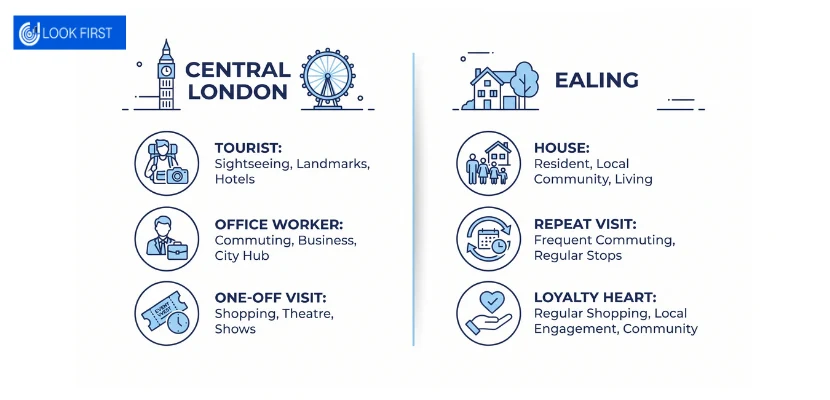
Central London businesses mostly sell to people who are already there for another reason. A tourist walking through Covent Garden, an office worker grabbing lunch near Liverpool Street, a shopper who’s come in specifically to visit Oxford Street. These customers often decide in the moment, compare options quickly, and are unlikely to return next week.
Ealing businesses mostly sell to people who live nearby and will be back. The customer base is smaller in raw numbers passing by the door, but far more likely to become repeat visitors, recommend the business locally, and choose based on convenience and familiarity rather than on which shopfront looked most eye-catching that day.
| Factor | Central London | Ealing |
|---|---|---|
| Typical customer | One-off visitor, tourist, commuter | Local resident, repeat customer |
| Decision driver | Convenience of location that day | Proximity, familiarity, trust |
| Competition type | Broad, high volume, national brands | Hyperlocal, other Ealing businesses |
| Search behaviour | Broad category searches | “Near me” and specific local searches |
| Customer relationship | Largely transactional | Often ongoing and personal |
This single difference, destination traffic versus residential catchment, is what actually drives every other tactical decision that follows.
Why Central London SEO Tactics Underperform In Ealing
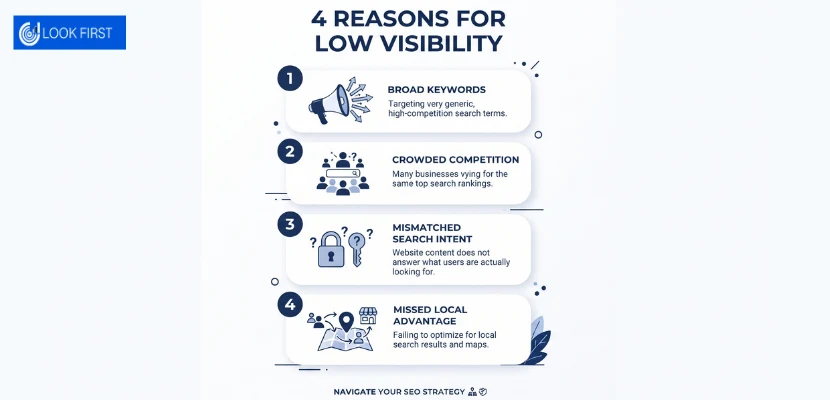
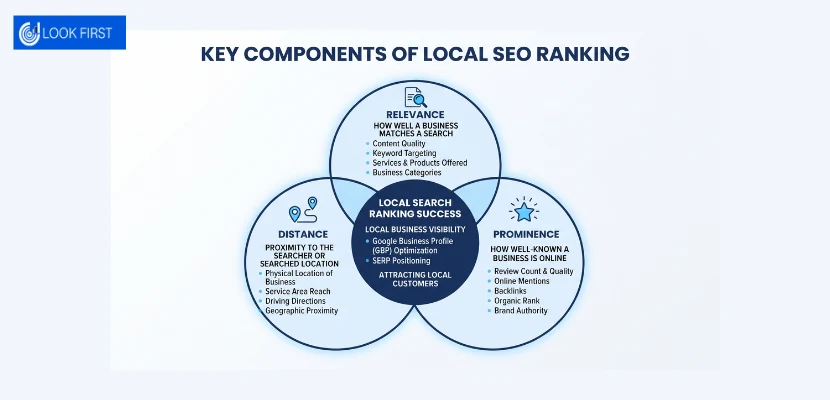
Central London SEO tactics underperform in Ealing for a few clear reasons: the keywords are too broad, the competition is the wrong kind, and the search intent doesn’t match how local residents actually search. If you want the fundamentals behind why local intent matters so much, our guide to local SEO covers that ground properly.
Broad, high-volume keywords
Central London SEO chases terms like “coffee shop London” because a large, transient audience keeps refreshing. That volume simply doesn’t exist at the same scale for an Ealing-specific search.
The wrong competition
A search for “digital marketing agency London” from Ealing competes against every agency in the capital, regardless of whether they’re anywhere near W5.
Mismatched search intent
Someone in Ealing searching for a service isn’t typing “best plumber London.” They’re typing something closer to “plumber near Ealing Broadway” or searching with location services switched on, expecting Google to already know where they are.
Wasted relevance advantage
A smaller Ealing-based business with genuinely local content, consistent citations and real local reviews will often outperform a much bigger, broader competitor for these specific searches, simply because Google can see it’s the closer, more relevant match.
How This Changes What Ealing Businesses Should Actually Do Online
Once you accept that the audience is fundamentally different, the rest tends to follow naturally rather than needing to be treated as separate problems.
A website built for Central London often prioritises a strong first impression above everything else, because it might only get one shot at a visitor who’ll never return. A website built for Ealing can afford to prioritise clarity and ease instead, since the same visitor is likely to return, check opening hours again, or use the contact form more than once.
The same shift shows up in social media. Central London content tends to chase reach, hoping to catch attention from a huge, constantly changing audience passing through. Ealing content tends to work better when it leans into community, tagging local landmarks, mentioning nearby streets, and building the kind of familiarity that turns a follower into a regular customer.
Even AI-powered search tools follow this same pattern. When someone asks ChatGPT or Google’s AI Overviews for a recommendation near Ealing specifically, a business with genuinely local, specific content has a real advantage over a much bigger competitor whose content was never written with any particular postcode in mind. Scale helps in Central London. Specificity helps in Ealing, and it’s worth understanding what AIO actually involves if this side of things is new to you.
How Commuter Patterns Are Changing Timing Too
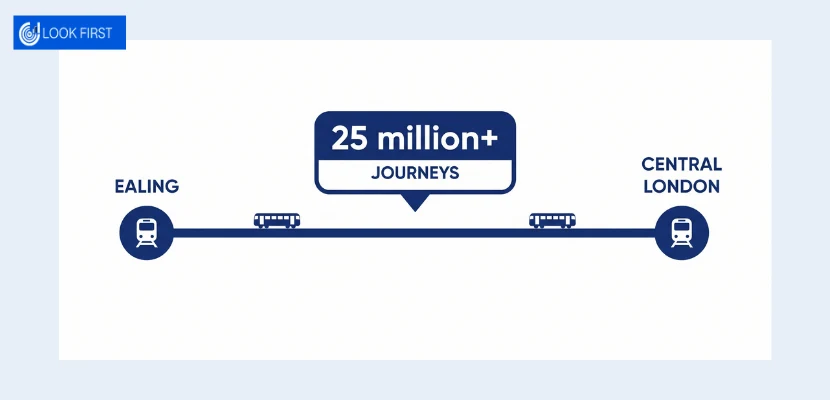
The Elizabeth Line has genuinely shifted how people move through Ealing, putting Central London destinations within easy reach and changing when locals are out and about. Ealing borough’s Elizabeth Line stations, Ealing Broadway, West Ealing, Southall and Acton Main Line, recorded over 25 million passenger journeys in their first two and a half years of operation, with Ealing Broadway alone accounting for the majority of that traffic.
That has knock-on effects on Ealing businesses’ footfall and search activity, which are worth their own detailed look.
Ealing Broadway vs Ealing Common: Even "Local" Isn't One Thing
It’s worth remembering that “Ealing” itself isn’t a single, uniform audience. Ealing Broadway, with its shopping centre and transport hub, has a different feel to the quieter, more residential area around Ealing Common.
Treating the two as identical for marketing purposes is its own version of the same mistake this article is about, just at a smaller scale.
A Practical Starting Point For Ealing Businesses
If you’re not sure where to begin untangling a Central-London-shaped strategy from what Ealing actually needs, a few starting points make the biggest difference:
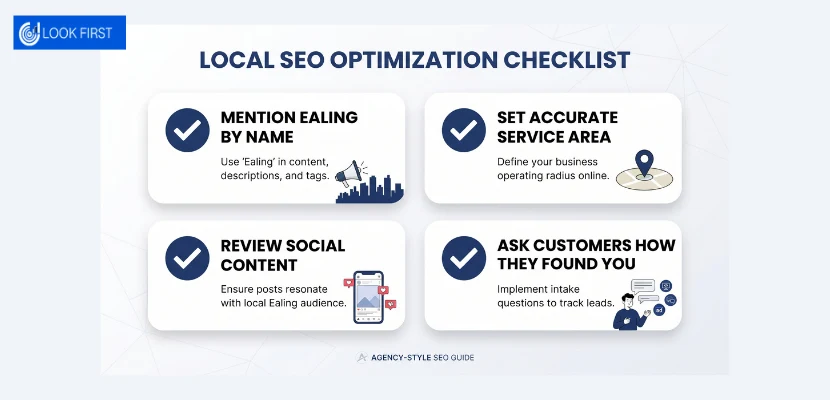
- Check whether your website content mentions Ealing by name, or specific streets and landmarks, rather than just “London”
- Look at your Google Business Profile and confirm your service area genuinely reflects Ealing and its immediate surroundings, not a vague citywide radius
- Review your social content for the last month and ask honestly whether it was written for a broad audience or a local one
- Ask a handful of regular customers how they actually found you, since the answer is often more local and more specific than any analytics dashboard suggests
If you’re also trying to work out how ChatGPT, AI Overviews and traditional Google results actually differ before acting on any of this, our GEO vs SEO vs AEO comparison breaks that down clearly.
Conclusion
The gap between Ealing and Central London marketing isn’t really about budget or effort. It’s about starting from the right assumption about who’s actually reading, searching and deciding.
Central London rewards scale and broad visibility because its audience is constantly refreshing. Ealing rewards specificity and local trust because its audience mostly stays the same, week after week. Businesses that build their marketing around that difference tend to see it show up in the results before their competitors even notice what changed.
If you’d like a clearer picture of where your Ealing business currently stands, a free audit from Look First Marketing will show you exactly what to prioritise first.
FAQS
Yes. Central London SEO tends to chase broad, high-volume keywords for a large transient audience. Ealing SEO performs better when it targets specific, local search intent, since residents typically search with location in mind rather than broad citywide terms.
Largely yes. Central London sites often prioritise a strong first impression for one-off visitors. Ealing sites benefit more from clarity and ease of repeat use, since local customers are far more likely to return to the same website multiple times.
It is. Central London social content usually chases broad reach across a constantly changing audience. Ealing social content performs better when it builds community by referencing local landmarks and streets, turning casual followers into genuine repeat customers.
Yes. AI tools like ChatGPT and Google’s AI Overviews tend to favour broader, more authoritative sources for generic queries, but reward genuinely specific, local content when someone searches for something near Ealing in particular.
Assuming their customer behaves like a one-off visitor rather than a returning local. This leads to broad, generic marketing that ignores the proximity, familiarity and repeat-visit patterns that actually drive decisions in a residential area like Ealing.