
What Is AIO And Why London Businesses Need It In 2026
A few years ago, the only thing standing between a customer and your business was a Google search. Type a query, scroll through some links, click the one that looks most promising. Simple.
That’s no longer the whole story. Increasingly, the thing standing between a customer and your business is an AI system that does the searching, comparing, and sometimes even the buying on the customer’s behalf. ChatGPT and other AI platforms now generate over 50 million shopping-intent visits a month to UK retailers alone. AI-referred traffic to UK retail sites grew 180% year on year as of March 2026, and the revenue gap between an AI-referred visit and an average visit narrowed from 83% behind to just 18% behind in twelve months, according to Adobe’s data. This isn’t a niche behaviour any more. It’s becoming the default starting point for a growing share of research and buying decisions.
So the question worth asking isn’t just “will my business rank on Google?” It’s “can an AI system even find, understand, and trust my business enough to recommend it, or act on it?”
That’s the question AIO exists to answer. If you’ve already read our comparison of GEO vs SEO vs AEO, this article sits one level above it. AIO is the umbrella. GEO and AEO are two of the disciplines that sit underneath it. By the end of this guide, you’ll know exactly what AIO means, how it’s different from the terms you already know, and what a London business actually needs to do about it in 2026.

What Is AIO (Artificial Intelligence Optimisation)?
AIO stands for Artificial Intelligence Optimisation. In simple terms, it’s the practice of making your business, your website, and your content understandable, trustworthy, and usable by any AI system that might encounter them, whether that system is answering a question, recommending a business, or, increasingly, taking action on a customer’s behalf.
That last part is the piece most explanations of AI search miss. Generative Engine Optimisation and Answer Engine Optimisation both concern AI systems that generate answers or citations. AIO covers that too, but it also covers something newer: AI agents that don’t just talk; they act. They browse product pages, compare prices, fill in forms, and, in an increasing number of cases, complete a purchase or booking without a human clicking anything at all.
Put another way, GEO and AEO ask “will the AI mention me?” AIO asks a broader question: “Can any AI system, whether it’s answering, recommending, or transacting, actually work with my business?”
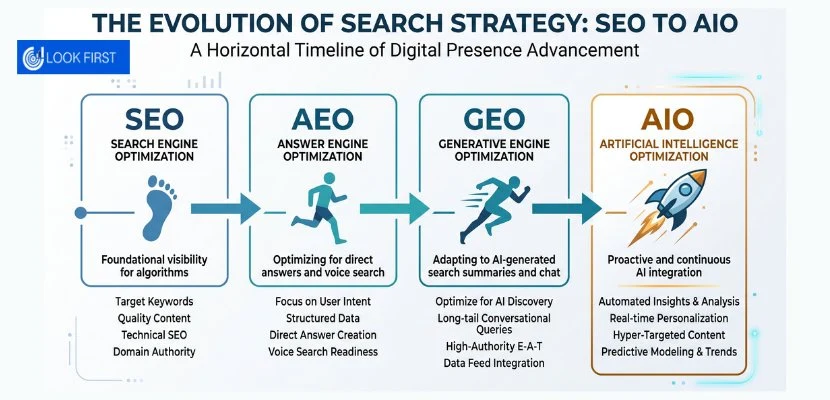
AIO vs GEO vs AEO vs SEO: How They Relate
These four terms are often used interchangeably in much marketing content, which is part of why business owners find this space confusing. Here’s how they actually fit together.
Think of AIO as the roof, not another wall. It doesn’t replace SEO, AEO, or GEO. It sits above them, adding a layer that specifically accounts for AI agents that browse and act, not just AI that answers.
| Discipline | What it optimises for | Primary platforms | Goal |
|---|---|---|---|
| SEO | Ranking in traditional search results | Google, Bing | Drive clicks to your website |
| AEO | Being the direct answer inside AI features | Google AI Overviews, featured snippets, voice search | Own the answer box |
| GEO | Being cited or recommended by generative AI | ChatGPT, Perplexity, Gemini, Copilot | Be mentioned in AI-generated responses |
| AIO | Being findable, trustworthy, and actionable to any AI system, including agents | All of the above, plus autonomous AI agents and shopping tools | Be visible, cited, and where relevant, transacted with |
Why AIO Isn't Just A Rebrand Of GEO?
It’s a fair question. If you’ve already read our article on GEO (Generative Engine Optimisation), this might sound similar. The distinction matters, though, and it comes down to one word: action.
GEO is about being cited when an AI generates an answer. AIO includes that, but it goes further to cover whether an AI agent can actually do something useful with your business once it finds you. Can it read your pricing accurately? Can it check your availability? Can it complete a booking or a purchase using structured, reliable data, rather than guessing from a wall of unstructured text?
A recent scan of the web’s top 1,000 most-linked sites found that 57% showed an AI agent little more than a blank page until JavaScript had run, content that’s perfectly visible to a human browser but invisible to an AI system reading the raw page. That gap between “readable by humans” and “readable by machines” is exactly what AIO closes.

Why AIO Matters For London Businesses In 2026
London has always been a fiercely competitive market for digital visibility. The businesses that adapt early to how AI search and AI agents actually work stand to gain the same kind of first-mover advantage that early SEO adopters enjoyed a decade ago.
AI Agents Are Starting To Shop, Compare, And Book
This isn’t a future scenario anymore. According to the IBM Institute for Business Value, 45% of consumers already use AI for at least part of their buying journey. Adyen found that AI assistant usage among UK shoppers doubled from 12% to 28% in a single year, and 44% of UK shoppers said they’d let an agent handle the whole purchase process once they’ve set a budget and brand preference.
On the merchant side, the UK lags behind demand. A Payments Association survey found that 58% of UK online merchants believe AI agents have already reached their platforms, yet only 3% of transactions currently involve an AI agent. That gap between “we know it’s happening” and “we’re ready for it” is precisely where the opportunity sits.
Most Businesses Are Still Invisible To AI Systems
Genuinely, most competitors haven’t started thinking about this yet. Adobe’s machine-readability research suggests a large share of business websites simply aren’t structured in a way AI systems can confidently work with. If your competitors’ pricing, service areas, and availability are buried in inconsistent copy or missing structured data entirely, an AI agent is more likely to skip past them in favour of a business that’s easier to parse.
Early-Mover Advantage Is Still Wide Open
The pattern here mirrors what happened with SEO in its early years and with GEO more recently. Businesses that get their entity data, structured markup, and AI accessibility sorted now are the ones most likely to become the “default” a system trusts and keeps returning to, well before this becomes standard practice across every industry.
Trust Signals Compound Over Time
AI systems, whether they’re generating an answer or executing a transaction, tend to favour sources that already show consistent, verifiable information across multiple places. The same trust-building work that strengthens traditional SEO, things like consistent business details, genuine reviews, and clear expertise, also strengthens how confidently an AI system will act on your behalf.
Core Elements Of An AIO Strategy
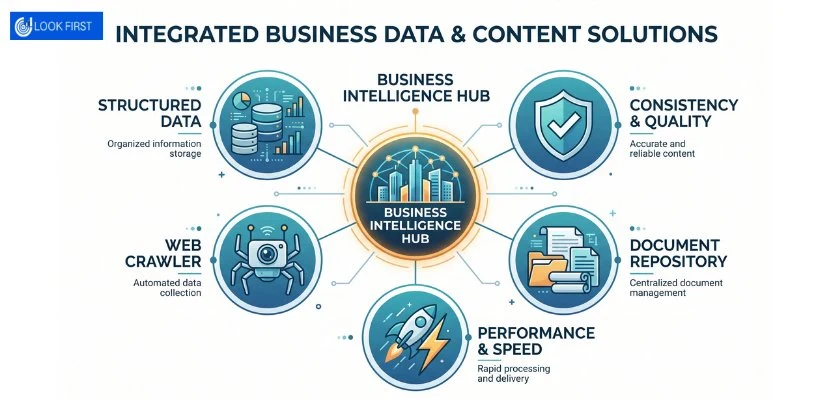
AI systems, whether they’re generating an answer or executing a transaction, tend to favour sources that already show consistent, verifiable information across multiple places. The same trust-building work that strengthens traditional SEO, things like consistent business details, genuine reviews, and clear expertise, also strengthens how confidently an AI system will act on your behalf.
Machine-Readable Content And Structured Data
This is the foundation. Schema markup, clean HTML structure, and a logical page hierarchy all help AI systems understand exactly what a page is about without having to infer it from loosely written prose. For a local business, that means structured data for your services, pricing, opening hours, service areas, and reviews.
AI Crawler Access: Robots.txt And llms.txt
Most businesses have never checked whether their robots.txt file allows or blocks crawlers used by AI systems such as GPTBot, ClaudeBot, or PerplexityBot. If they’re blocked, either deliberately or accidentally due to an outdated developer setting, your content simply doesn’t exist as far as those systems are concerned.
llms.txt is a newer, simpler idea worth understanding. It’s a plain text file placed at the root of a website that gives AI systems a clean, concise summary of what your site offers and where to find the most important content, a bit like a sitemap written specifically for AI models rather than search engine crawlers. Very few UK businesses have implemented one yet, which makes it a genuinely low-competition, high-value step.
Entity And Brand Consistency Across The Web
Your business name, address, phone number, services, and description need to match across your website, Google Business Profile, directories, and social platforms. Inconsistencies confuse AI systems in exactly the same way they confuse traditional search engines, except the cost of confusion is higher: an AI agent that isn’t confident in your details is more likely to skip you entirely rather than guess.
Authoritative, Agent-Friendly Content
Generative AI systems and shopping agents both favour content that demonstrates genuine expertise rather than generic filler. For a service business, that might mean clear, specific pricing guidance, honest descriptions of what’s included, and detailed service area pages, exactly the kind of content that gives an AI agent enough confidence to recommend you rather than a vaguer competitor.
Technical Foundations: Speed, Crawlability, And Security
AI agents don’t have the patience a human visitor might. A slow, broken, or blocked page gets abandoned quickly, and an agent that can’t complete a task on your site will simply try a competitor’s instead.
What Happens If You Ignore AIO?
The risk isn’t abstract. It’s the same risk that GEO and AEO already carry, extended one step further.
If your business ignores AIO, you’re not just risking lower rankings. You’re risking becoming invisible to an entire, fast-growing layer of AI-mediated discovery and commerce. An AI agent that can’t read your pricing accurately won’t recommend you. One that can’t verify your service area won’t book with you. And unlike a human visitor who might dig around a confusing website out of curiosity, an AI agent will simply move on to whichever competitor made the job easier.
For service-based businesses that compete heavily on trust and local reputation, being the option an AI agent confidently selects could become just as valuable as ranking first on Google once was.
A Practical AIO Checklist For London Businesses
If you’re starting from nothing, here’s a sensible order to work through:
- Audit your current AI visibility.
Ask ChatGPT, Gemini, and Perplexity questions a customer might genuinely ask about your industry and location, and see whether your business appears and whether the details are accurate.
- Fix entity consistency across the web.
Align your business name, address, phone number, and service descriptions across your website, Google Business Profile, and directories.
- Add structured data to your key pages.
Prioritise your services, pricing, FAQs, and reviews.
- Check your robots.txt file.
Confirm it isn’t accidentally blocking reputable AI crawlers.
- Publish an llms.txt file.
A short, clear summary of your site aimed at AI systems rather than human readers.
- Rewrite key pages in direct, unambiguous language.
Lead with a clear answer, then add supporting detail.
- Build genuine topical authority.
Publish original content that reflects real expertise rather than repeating what’s already widely available.
- Monitor your AI visibility over time.
This space is moving quickly. What works today will need revisiting within months, not years.
Which Businesses Need AIO First?
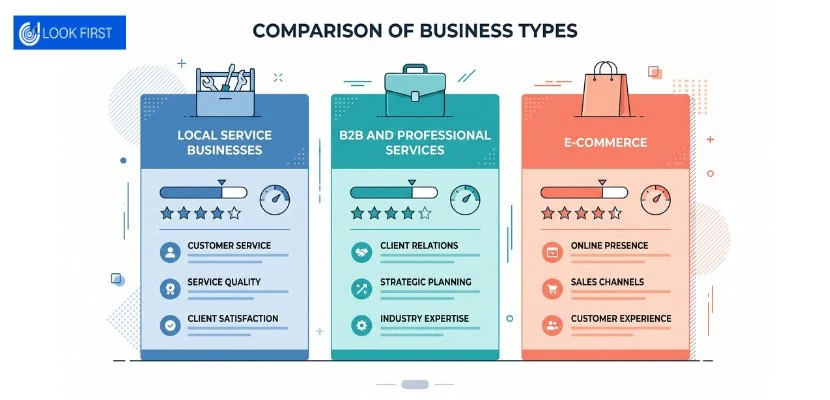
Not every business needs to prioritise this equally right now. Here’s a rough guide based on how AI agents currently behave in each sector.
Local service businesses (roofers, driveway specialists, tradespeople, and similar) are booking and quote-driven, which makes them a natural fit for AI agent interaction as this technology matures. Getting service area pages, pricing clarity, and structured FAQs in order now positions you well; the same fundamentals are covered in our guide to local SEO.
B2B and professional services face the fastest-moving shift. Research increasingly shows that decision-makers are turning to AI tools before they ever speak to a salesperson, making both GEO and AIO immediately relevant rather than optional extras.
E-commerce brands are at the sharpest edge of this change. With AI-referred shopping traffic and conversion rates both climbing fast in 2026, and a significant share of product pages still not fully machine-readable, structured product data has become a genuine competitive lever rather than a technical nice-to-have.
Our AIO Strategy That Worked
Take a real example from our own client work. One London restaurant we worked with came to us with just 1.5K monthly visits and an authority score of 10, practically invisible online despite a genuinely great product. Part of fixing that meant restructuring their content so it wasn’t just readable by a human scanning a menu page; it was structured clearly enough for Google’s AI Overviews to pull from directly. Twelve months later, that business is visible for 436 keywords inside AI Overviews alone, on top of growing from 1.5K to over 20K monthly visits.
That’s the practical version of what this article is describing. The work isn’t abstract. It’s the difference between a menu an AI system can confidently summarise and one it skips past because the information isn’t structured clearly enough to trust.
Why Choose Look First Marketing For AIO Services
Most London agencies are still selling the SEO playbook they were using five years ago, with AI visibility bolted on as an afterthought, if it’s mentioned at all. At Look First Marketing, a results-driven digital marketing agency in London, we built our AIO services in London around how AI systems and AI agents actually work today, not as a rebrand of an existing service.
We combine solid technical SEO foundations with structured data implementation, entity consistency work, and AI crawler accessibility audits, then track how your business actually appears and performs across ChatGPT, Gemini, Perplexity, and Google’s AI features. If you want to know where your business currently stands, Get in touch with our team for a free AIO audit.
Conclusion
SEO, AEO, GEO, and AIO aren’t four competing trends fighting for your marketing budget. There’re layers of the same underlying shift: search has stopped being purely about links and has started being about whether AI systems of every kind can find, trust, and act on your business.
SEO remains the foundation on which everything else is built; see our complete SEO guide for the groundwork. AEO wins you the answer box. GEO gets you cited across generative platforms. AIO makes sure that when an AI agent is doing the finding, comparing, or even the buying, your business is one it can actually work with.
Very few London businesses have started taking this seriously yet. That gap won’t stay open for long. The businesses that get their structured data, entity consistency, and AI accessibility right now are the ones most likely to be the default an AI system reaches for once this becomes standard practice across every industry, not just the early ones.
Ready To Find Out Where You Stand?
Get in touch with Look First Marketing for a free, no-obligation AIO audit. We’ll show you exactly how visible, trustworthy, and actionable your business currently looks to AI systems, and what to prioritise first.
FAQS
AIO stands for Artificial Intelligence Optimisation. It’s the practice of making a business machine-readable, trustworthy, and usable to AI systems, including AI agents that browse, compare, and transact on a user’s behalf.
No. GEO (Generative Engine Optimisation) focuses specifically on being cited or recommended in AI-generated answers. AIO is the broader umbrella, covering GEO along with AI agents that take action, such as comparing products or completing a booking or purchase.
SEO optimises for ranking in traditional search engine results and driving clicks. AIO optimises for being understood and trusted by AI systems more broadly, including ones that never produce a traditional results page at all.
An AI agent is a system that can browse, compare, and in some cases complete tasks such as bookings or purchases on a user’s behalf, with limited or no direct human input at each step. If your business information isn’t structured clearly, an AI agent is more likely to skip it in favour of a competitor it can parse with confidence.
llms.txt is a simple text file placed at the root of your website that gives AI systems a clear summary of your site’s most important content. Very few UK businesses currently have one, making it a straightforward, low-competition step to take.