
What Is GEO And Why London Businesses Need It In 2026
Search has changed more in the last two years than it did in the previous decade. Instead of typing a query into Google and scrolling through ten blue links, more and more people are asking ChatGPT, Perplexity, or Google’s AI Overviews a direct question and getting a direct answer, often without ever clicking through to a website.
For London business owners, this shift raises an uncomfortable question: if customers are getting their answers from AI rather than search results, how do you ensure your business is the one being recommended? Traditional digital marketing services in London have always focused on climbing the rankings on Google’s results page, but that’s no longer the full picture. The businesses winning customers in 2026 are the ones already thinking beyond the search results page toward the answers AI tools provide directly.
That’s where GEO comes in.
What Is GEO (Generative Engine Optimisation)?
Generative Engine Optimisation, or GEO, is the practice of optimising your online content so that AI-powered tools- ChatGPT, Google Gemini, Perplexity, Claude, and Google’s AI Overviews- are more likely to find, understand, and reference your business when generating answers to user queries.
Think of it as the natural evolution of SEO. Traditional SEO is built around ranking in search results. GEO is built around being the source an AI model pulls from, summarises, and cites when it answers a question directly; see our complete SEO guide for the foundation GEO builds on.
The core difference comes down to how each system works:
Traditional search engines crawl and index web pages, then rank them based on relevance, authority, and hundreds of other signals, returning a list of links for the user to click through.
Generative engines don’t return a list. They synthesise an answer from multiple sources and present it as a single, conversational response, sometimes with citations, sometimes without.
If your content isn’t structured in a way these systems can easily understand and trust, you simply won’t appear in that synthesised answer, no matter how well you used to rank on page one of Google.

Why GEO Matters For London Businesses Specifically
London is one of the most competitive digital markets in the UK. Thousands of businesses are already competing for the same SEO keywords, such as “best accountant in London,” “plumber near me,” “London marketing agency,” and so on. That competition has only intensified as AI search adoption grows.
A few reasons GEO is particularly urgent for London businesses right now:
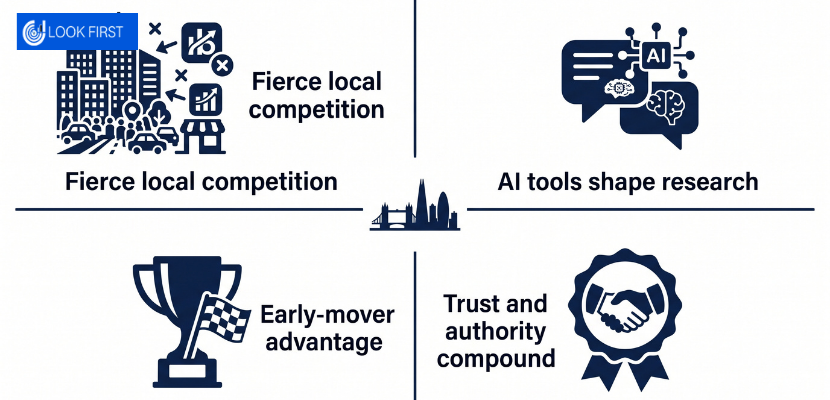
Local competition is fierce
With so many businesses targeting the same high-value London keywords, traditional SEO alone is becoming increasingly difficult and expensive. GEO offers a relatively uncontested space, since most local competitors haven’t yet started optimising for it.
AI tools are increasingly part of how Londoners research purchases
Whether someone is searching for a restaurant in Notting Hill, a roofer in Wiltshire, or a digital marketing agency in London, AI chat tools are increasingly part of that research journey, sitting alongside or even replacing a traditional Google search.
Early movers get disproportionate advantage
Because GEO is still new, businesses that optimise now are more likely to become the “default” sources these AI tools rely on and continue to cite, similar to how early SEO adopters dominated search results for years afterwards.
Trust and authority compound
AI models tend to favour content from sources that already demonstrate clear expertise, consistent information, and structured data. Building this now means your business becomes more deeply embedded in AI training and retrieval as these tools continue to evolve.
How GEO Differs From Traditional SEO
| Factor | Traditional SEO | GEO |
|---|---|---|
| Goal | Rank in search results (page one) | Be cited or referenced in AI-generated answers |
| Output | A list of links | A single synthesised answer |
| Key signals | Backlinks, keywords, page authority | Clarity, structured data, entity consistency, factual accuracy |
| Content style | Optimised for scanning and clicking | Optimised for direct quoting and summarising |
| Measurement | Rankings, organic traffic, click-through rate | Share of AI citations, brand mentions across AI platforms |
Core Elements Of A GEO Strategy
1. Clear, well-structured content
AI models favour content that directly and unambiguously answers a question. This means using clear headings, concise definitions, and a logical structure rather than dense, unstructured paragraphs. If you’re also weighing up AEO, our full breakdown of GEO vs SEO vs AEO covers exactly how the three overlap and differ.
2. Structured data and schema markup
Schema markup helps AI systems understand exactly what your content is about, your services, your location, your reviews, and your FAQs in a machine-readable format rather than forcing the AI to interpret unstructured text.
3. Entity and brand consistency
AI models build a picture of your business across multiple sources. Consistent business information (name, services, location, contact details) across your website, Google Business Profile, directories, and social platforms helps reinforce your business as a recognised, trustworthy entity.
4. Authoritative, original content
Generative engines tend to favour content that demonstrates genuine expertise and provides original insight, rather than content that simply rephrases what’s already widely available elsewhere.
5. Featured snippet and answer-style formatting
Content written in a direct question-and-answer format, with concise answers near the top, is more likely to be picked up and quoted by AI tools generating responses.

What Happens If You Ignore GEO?
Businesses that don’t adapt risk becoming invisible in an entire emerging channel of customer discovery. As more Londoners turn to AI tools for recommendations and research, businesses that haven’t optimised for generative engines may simply never enter the conversation, even if they rank well in traditional search.
This is particularly significant for service-based businesses competing on trust and local reputation, where being the AI’s go-to recommendation could become as valuable as ranking number one on Google once was.
Real Examples Of GEO In Action
To understand why this matters, it helps to picture how AI tools actually respond to commercial queries.
If someone in Shoreditch asks ChatGPT “who’s a good digital marketing agency in London,” the model doesn’t crawl Google in real time and return ten links. Instead, it draws on a combination of its training data and, increasingly, live web retrieval, and then synthesises a short, confident answer that names one or two businesses it considers credible.
The businesses that get named tend to share common traits: clear, consistent descriptions of what they do across multiple sources, structured information that’s easy to parse, genuine reviews and case studies, and content that directly answers the kind of question being asked rather than vague marketing copy.
The same pattern plays out across industries. A restaurant asking “best tapas restaurant near Notting Hill” needs consistent NAP (name, address, phone) data, strong review signals, and clear menu/cuisine information across its website and listings, the same fundamentals covered in our guide to what local SEO involves.
A Practical GEO Checklist For London Businesses
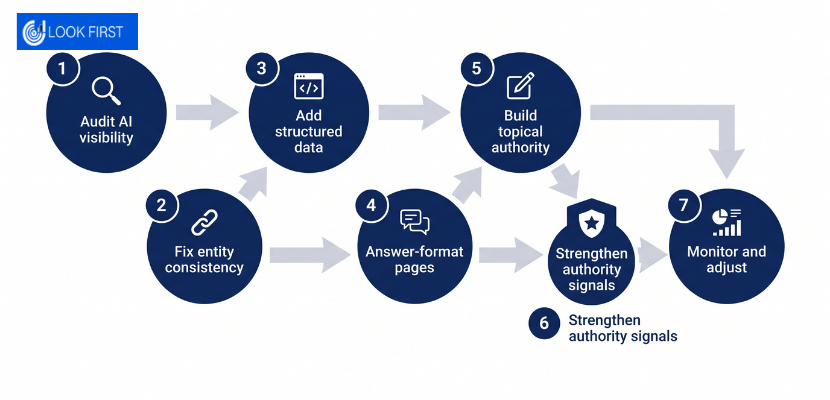
If you’re starting from scratch, here’s a practical sequence to work through:
1. Audit your current AI visibility
Before optimising anything, find out where you currently stand. Ask ChatGPT, Perplexity, and Gemini questions a potential customer might ask about your industry and location, and see whether your business comes up, how it’s described, and whether the information is accurate.
2. Fix entity consistency across the web
Make sure your business name, address, phone number, services, and description are identical across your website, Google Business Profile, directory listings, and social media profiles. Inconsistencies confuse AI models just as they do traditional search engines.
3. Add structured data to key pages
Implement schema markup for your organisation, services, FAQs, and reviews. This gives AI systems a machine-readable summary of exactly who you are and what you offer, rather than forcing them to infer it from prose.
4. Rewrite key pages in a direct answer format
For your most important service and location pages, add a clear, concise answer near the top of the page that directly addresses the most common question a customer would ask, followed by supporting detail underneath. This format is far more likely to be lifted and cited by an AI model than a long, meandering introduction.
5. Build genuine topical authority
Publish original, well-researched content that demonstrates real expertise, rather than generic content that’s already widely available elsewhere. AI models are trained to favour sources that add genuine insight over those that simply repeat common knowledge.
6. Strengthen off-site authority signals
Reviews, press mentions, case studies, and backlinks from credible sources all feed into how trustworthy an AI model judges your business to be. The same authority-building work that supports traditional SEO also strengthens your GEO performance.
7. Monitor and adjust
GEO is new enough that best practices are still evolving. Track how your business appears across AI platforms over time and adjust your content and structured data accordingly.
Getting Started With GEO
GEO is still an emerging discipline, but the fundamentals are clear: structure your content for clarity, build consistent entity signals across the web, and create genuinely authoritative content that AI systems can confidently cite.
For London businesses, the opportunity right now is significant. Most competitors haven’t started optimising for generative engines yet, which means the businesses that act early have a real chance to establish themselves as the trusted, recommended source before the space becomes as competitive as traditional SEO.
Why Choose Look First Marketing For GEO Services
Most London agencies are still selling the same SEO playbook they were five years ago, with no real strategy for how AI search is reshaping customer behaviour. At Look First Marketing, our GEO services in London are built into our approach from the ground up, not bolted on as an afterthought.
We combine a strong technical SEO foundation with active tracking of how platforms like ChatGPT, Gemini, and Perplexity actually source and cite content, then align your business information consistently across the web and create genuinely useful, clearly structured content these engines want to reference. As one of the first London agencies to build a dedicated GEO offering, we’re not retrofitting old tactics to fit a new trend; we built our process around how AI search works from day one.
If you’re ready to make sure your business is visible across ChatGPT, Perplexity, Google AI Overviews, and beyond, get in touch with our team for a free GEO audit and find out exactly where your business stands today.
Conclusion:
AI is changing the way people search, research, and decide who to trust, and that shift isn’t slowing down. For London businesses, this means the old rulebook of ranking on page one of Google is no longer the whole story. Being the answer an AI tool gives, rather than just one of ten links it returns, is quickly becoming just as important.
The good news is that GEO isn’t a separate, disconnected discipline you need to start from scratch. It builds directly on the SEO fundamentals most businesses already understand: clear content, structured data, consistent business information, and genuine authority. What’s changed is the audience: you’re no longer optimising purely for a search algorithm; you’re optimising for an AI model trying to give its user the single best answer possible.
Right now, very few London businesses have started taking GEO seriously, which means there’s a real window of opportunity to get ahead. The businesses that invest in entity consistency, structured data, and genuinely authoritative content today are the ones most likely to become the trusted, go-to recommendation when someone asks ChatGPT, Gemini, or Perplexity who to call.
The question isn’t whether AI search will keep growing; it’s whether your business will be visible when it does.
FAQS
No. A strong technical and on-page SEO foundation is what allows AI models to crawl, index, and understand your content in the first place. GEO builds on top of that foundation rather than replacing it.
Because generative engines update and retrain on different timelines than traditional search indexes, results can vary. Some changes, like fixing structured data or entity consistency, can influence AI responses relatively quickly, while building broader topical authority is a longer-term effort, similar to traditional SEO.
Yes, in many cases more easily than in traditional SEO. Generative engines often favour clear, specific, well-structured local content over broad brand authority alone, giving smaller, well-optimised local businesses a genuine opportunity to be cited ahead of larger competitors that haven’t yet adapted.
ChatGPT, Google’s AI Overviews, Perplexity, and Gemini are currently the most widely used by consumers researching local services and businesses, making them the priority platforms for most GEO strategies.
GEO (Generative Engine Optimisation) focuses on getting content cited inside AI-generated answers from tools like ChatGPT and Google AI Overviews. AIO (AI Optimisation) is the broader practice of making sure AI systems understand and recommend a business correctly across every touchpoint, not just search answers. GEO is essentially one major component of a wider AIO strategy.