
B2b Marketing In Canary Wharf: How Financial And Professional Firms Win Clients
Financial and professional firms in Canary Wharf win clients by being visible where buyers actually research: AI tools, LinkedIn and credible published expertise. Local search tactics that work elsewhere in London do very little here.
Nobody in Canary Wharf searches “accountant near me”. They ask ChatGPT which firms handle FCA-regulated clients, then check whether the answer looks credible.
If your marketing was built around Google rankings, map pack listings and review counts, it was built for a customer who doesn’t exist in E14. Here’s what does work.
What's Changed In B2B Buying In 2026
B2B buying moved into AI tools, and it moved fast.
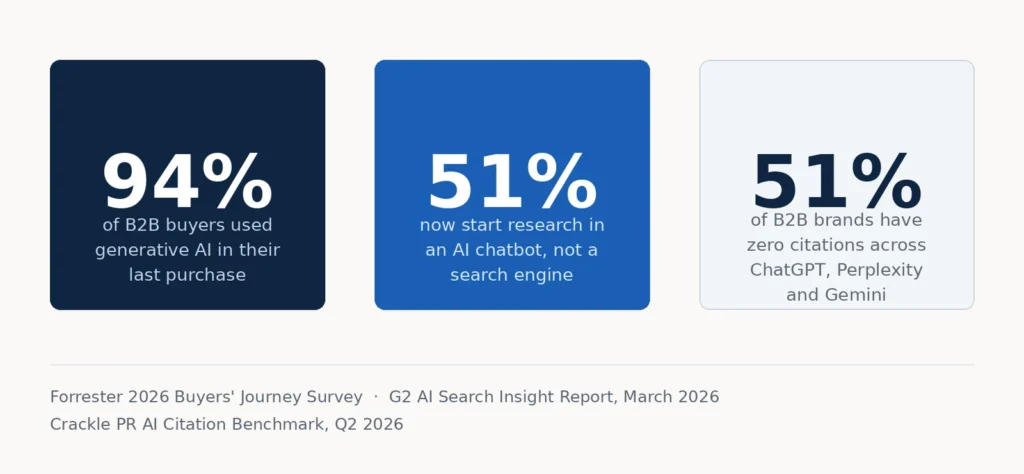
Forrester’s 2026 Buyers’ Journey Survey covered nearly 18,000 business buyers. It found 94% used generative AI during their most recent purchase, up from 89% in 2025. More importantly, 55% compared vendors inside AI tools, 54% researched products, and 47% built their internal business case, all before contacting a single supplier.
AI answer engines are now the number one vendor research source. They rank above vendor websites, sales reps and product experts.
G2 surveyed 1,076 B2B buyers in March 2026 and found 51% now start their research in an AI chatbot rather than a search engine. Comparing vendor strengths and weaknesses was the top use case, at 41%.
And the gap most firms haven’t noticed: Crackle PR’s Q2 2026 benchmark found that 51% of B2B tech brands have zero citations across ChatGPT, Perplexity and Gemini.
Half of buyers start in AI. Half of vendors don’t appear there at all.
Why Local Seo Doesn't Work In Canary Wharf
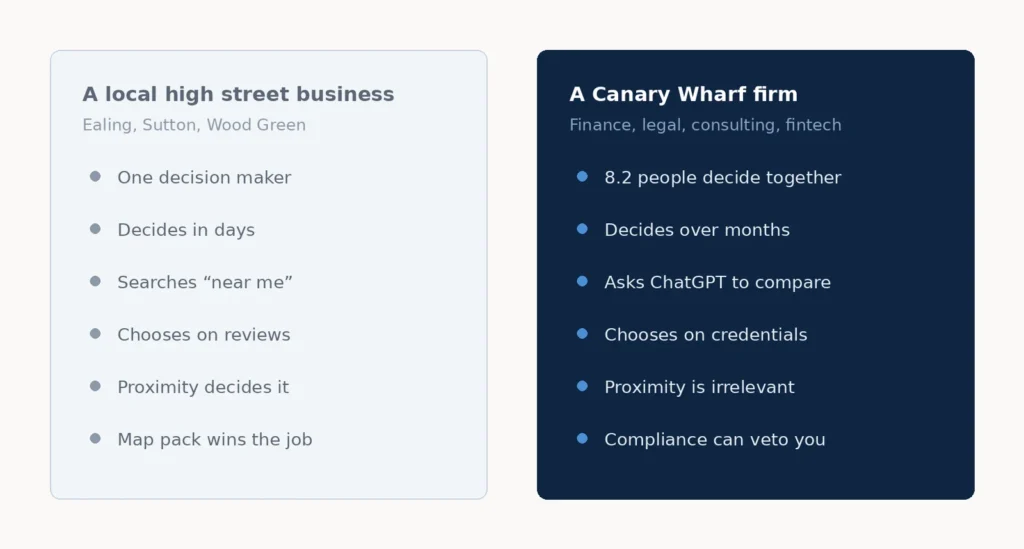
Local SEO works on proximity. Google shows searchers what’s nearby, weighted by distance, reviews, and category. Canary Wharf buyers don’t behave that way. A compliance director choosing an audit firm doesn’t care that you’re four minutes away. They care whether you’ve handled their regulatory situation before.
Three specific differences:
- One person doesn’t make the decision
Gartner’s 2026 research puts the median B2B buying committee at 8.2 people. Your website has to convince a partner, a compliance lead, a finance director, and a procurement contact, each with different priorities.
- Nobody contacts you early
Gartner counts a median of 17 touchpoints before a buyer talks to sales. By the time your phone rings, they’ve already decided you’re plausible.
- Proximity is irrelevant; credentials aren’t
Being in E14 helps with credibility, not rankings. Say it, but don’t build your strategy on it.
The Compliance Problem Nobody Solves
This is where most agencies fail Canary Wharf firms, and it’s worth understanding before you hire anyone.
The UK financial promotions regime in 2026 is the strictest it has ever been. The Consumer Duty adds an outcomes test to every promotion, and PRIN 2A.5 requires firms to genuinely equip customers to make informed decisions. A promotion that complies with the letter of COBS 4 can still fail.
For marketing, three FCA rules matter most:
- Standalone compliance
Every promotion is judged on its own. A LinkedIn post that links to a balanced landing page isn’t enough; the post itself must be balanced.
- Prominence
Risk information can’t sit behind a “see more” button or get cropped by a platform’s design.
- You’re responsible when others share it
If a third party retweets your promotion, any breach is still yours.
This is why generic marketing agencies struggle here. A campaign that works for a plumber can create a regulatory problem for a wealth manager. Your agency doesn’t need to be authorised, but it does need to write with sign-off in mind and route content through your compliance team before publication, not after.
What Actually Works In Canary Wharf
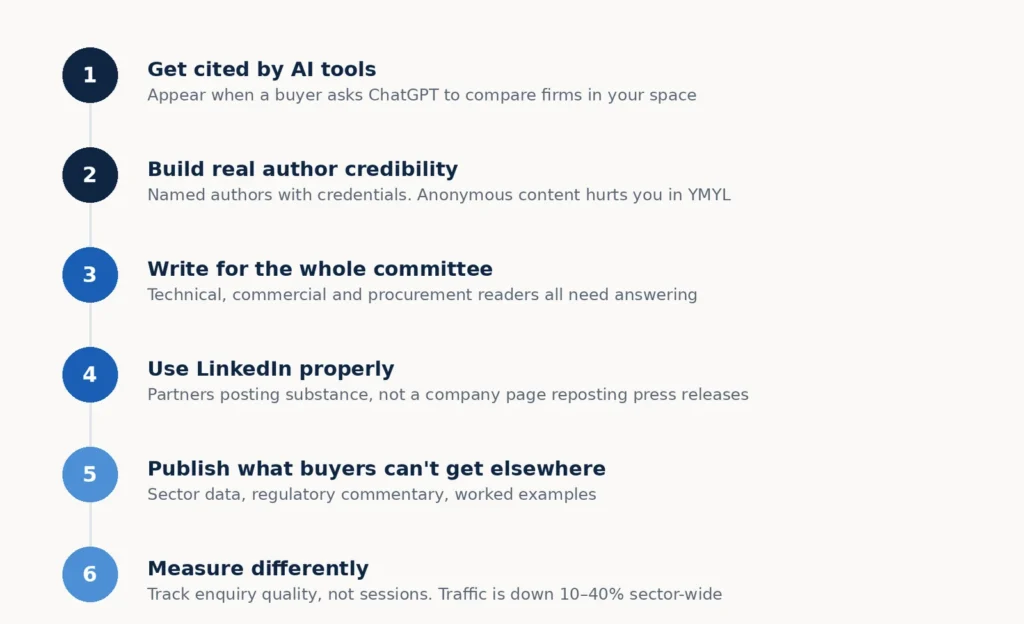
This is the part that matters. Six things, in order of impact: do them in this order, because the first two change what the rest are worth.
1. Get cited by AI tools, not just ranked by Google
When a buyer asks ChatGPT to compare firms in your space, you either appear, or you don’t. Getting cited means publishing clear, factual, well-structured content that answers specific questions, and being mentioned on third-party sites the models trust. Our guides to what GEO is and how GEO, SEO and AEO differ cover the mechanics.
2. Build real author credibility
Financial services is a YMYL (Your Money or Your Life) category, which Google and AI models hold to a higher standard. Named authors with real credentials, proper bio pages, and content that reads like it was written by someone qualified. Anonymous blog posts actively hurt you here. See our guide to E-E-A-T in SEO.
3. Write for the whole committee
One page for the technical buyer, one for the commercial one, one that answers procurement’s questions about insurance, contracts and data handling. Most firms write only for the person they enjoy talking to.
4. Use LinkedIn properly
It’s where Canary Wharf buyers actually are. That means individual partners posting substance, not a company page reposting press releases. Personal accounts consistently outperform brand accounts in this sector.
5. Publish what buyers can’t get elsewhere
Sector data, regulatory commentary, worked examples. AI tools cite this, and buying committees share it. Generic “5 tips” content does neither.
6. Measure differently
If your traffic has dropped 10–40% since 2025, that may not be a failure. B2B firms are reporting exactly that range as research moves into AI engines. Track enquiry quality and how new clients say they found you, not sessions.
How To Check If AI Mentions You
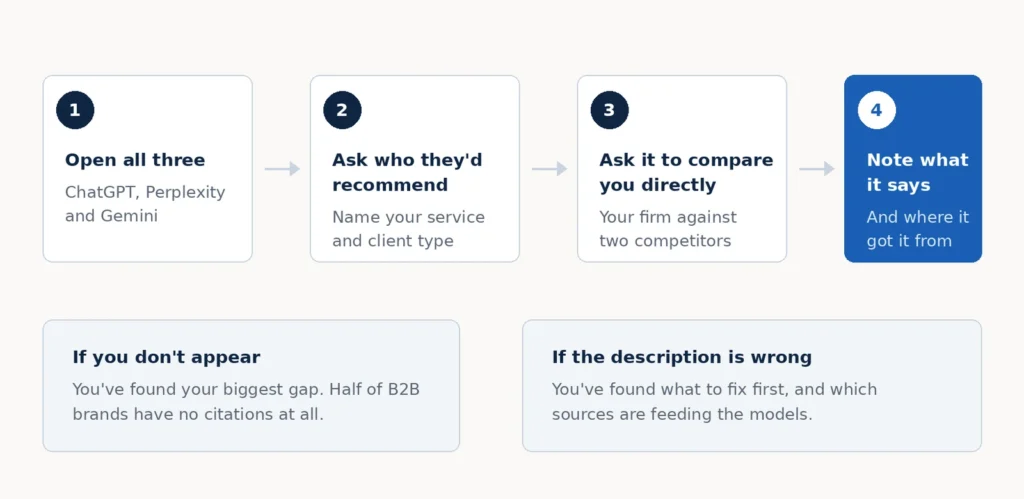
Do this today. It takes ten minutes, and most firms have never tried it.
- Open ChatGPT, Perplexity and Gemini.
- Ask each: “Which firms in Canary Wharf handle [your specific service] for [your client type]?”
- Then ask: “Compare [your firm] with [two competitors].”
- Note whether you appear, what the tools say about you, and where they got it from.
If you don’t appear, you now know your biggest gap. If you do appear but the description is wrong or outdated, you know what to fix first.
Our guide to AIO and why businesses need it explains what to do with the answers.
Five Things To Stop Doing
- Chasing map pack rankings: Low value in E14. Claim your profile, keep it accurate, move on.
- Review-count campaigns: Institutional buyers don’t choose an audit firm on Google reviews.
- Anonymous content: In a YMYL sector, it damages credibility rather than building it.
- Judging marketing on a consumer timescale: With 17 touchpoints and an eight-person committee, three months is not enough to conclude anything.
- Running B2B and consumer marketing the same way: If you’re a restaurant or gym serving the estate, almost none of this applies. That’s a genuinely different strategy.
Working With An Agency That Understands Regulated Marketing
Look First Marketing is a digital marketing agency in Canary Wharf working with professional and financial services firms across the Wharf, Wood Wharf and the wider Docklands. We build for how buyers research now: AI visibility, credible authorship, and content that survives compliance scrutiny.
Want to know where you stand? Ask us for an AI visibility check and we’ll show you exactly what ChatGPT, Perplexity and Gemini say about your firm today, and what’s feeding them. It’s the fastest way to find out whether your next client can find you at all.
FAQS
It depends on what you do. For restaurants, gyms and consumer services on the estate, yes. For B2B financial and professional services firms, no, buyers search by capability and credentials, not proximity. Claim your Google Business Profile, keep it accurate, and put your effort elsewhere.
Forrester’s 2026 survey of nearly 18,000 buyers found 94% used generative AI during their most recent purchase, up from 89% in 2025. G2 found that 51% now begin their research in an AI chatbot rather than a search engine.
Research is moving into AI tools, where most sessions end without a click. B2B firms are reporting traffic declines of 10–40% for this reason. If enquiry quality has held up, the drop may not indicate a problem, but it does mean session counts are no longer a useful measure on their own.
Yes, provided they write with the financial promotions regime in mind and route everything through your compliance team before publication. The agency doesn’t need to be authorised, but it does need to understand standalone compliance, prominence rules and Consumer Duty obligations.
Longer than consumer marketing. Financial services is a YMYL category, so search visibility typically takes four to six months to build. Add a median of 17 buyer touchpoints and an 8.2-person buying committee, and a realistic assessment window is nine to twelve months.
Ask ChatGPT, Perplexity and Gemini what they say about your firm. Half of B2B brands have no citations in these tools. Finding out which side of that line you’re on takes ten minutes and changes what you do next.