
Important Questions To Ask A Web Design Agency Before Hiring
Hiring the wrong web design agency is one of those mistakes that doesn’t show up straight away. That’s exactly why knowing the right questions to ask a web design agency before hiring matters more than most business owners realise. It shows up three months later, when your new site still isn’t ranking, your CMS is so locked down you can’t change a single word without emailing the agency, and the “quick fix” quote just landed at £450.
That’s not a rare story either. It’s one of the most common complaints in small-business forums and agency review threads: a site that looks fine but can’t be touched without going back to the original developer, cap in hand. Multiply that across every trade, hospitality and local service business signing website contracts each year, and it’s a genuinely widespread problem.
The good news is that most of these headaches are avoidable. A short, focused conversation before you sign anything usually tells you everything you need to know about how an agency actually operates, not just how good their pitch sounds.
This guide walks through 8 questions worth asking any web design agency before you commit, what a strong answer sounds like, and the red flags that suggest you should keep looking. If you’re weighing up a broader digital marketing partner rather than just web design, our guide on choosing the best digital marketing agency is worth reading too. There’s also a section on choosing a web design agency in London specifically, since local market knowledge does matter more than people expect.
What To Check Before You Ask A Single Question
Before you even get an agency on a call, there’s some groundwork you can do yourself. It takes twenty minutes and saves a lot of wasted meetings later.
Review Their Portfolio and Case Studies
Don’t just look at how the sites look. Click through to a few of them and check how they actually function. Is the navigation clear? Does it load quickly on your phone? Are the case studies specific, with real numbers, or vague claims like “we boosted their online presence”? If you’re not sure what to look for, our guide to good website design covers the specific elements to check.
Look for Industry-Relevant Experience
A roofing company and a boutique hotel need very different things from a website. One needs clear service area pages and fast quote forms. The other needs strong visuals and an easy booking flow. An agency that’s worked with businesses like yours before will already understand these nuances, which saves you time explaining the basics.
Check Independent Reviews, Not Just Testimonials on Their Site
Testimonials on an agency’s own homepage are, by definition, curated. Platforms like Clutch or a Google Business Profile give a more honest picture, including the odd critical review, which is often more useful than five-star praise alone.
Ask for Direct Client References, Not Just Written Reviews
A written review can be polished or selectively chosen. A short phone call with a past client is much harder to fake.
Ask the agency for two contacts from projects similar in size to yours. When you speak to them, ask what went wrong at any point, not just what went right. Every project hits a snag somewhere, and how an agency handled that snag tells you more than a five-star rating ever will.
8 Questions To Ask A Web Design Agency Before Hiring
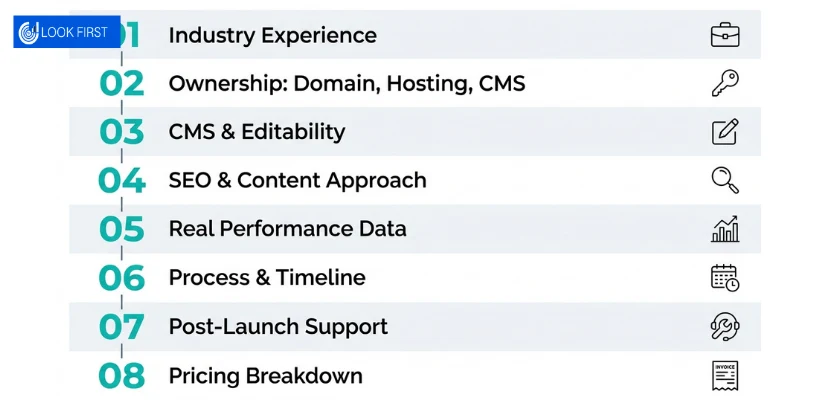
Once you’ve got a shortlist, these are the questions that separate agencies that talk a good game from those that deliver.
1. Do You Have Experience in My Industry?
This sounds obvious, but it’s worth pushing past the first answer. Ask for two or three specific examples, not just “yes, we’ve done a few.”
A strong answer includes detail: the type of client, the challenge they faced, and what the agency actually did differently because of that industry context. For example, a landscaping client might need seasonal service pages that shift emphasis between spring planting and winter garden clearance. An agency that mentions this unprompted knows the sector.
2. Who Owns the Website, Domain and Hosting After Launch?
This is really three separate questions, and most business owners only ask one of them.
- Domain ownership: is it registered in your name, or the agency’s?
- Hosting: can you move hosts if you’re unhappy, or is it tied exclusively to them?
- CMS access: do you get full admin login, or a restricted view-only account?
Ask each one separately. Agencies that dodge or bundle the answer together are often the ones that make switching providers later painful and expensive.
3. What CMS Will the Site Be Built On, and Can I Edit It Myself?
WordPress, Webflow, Squarespace and Wix all allow non-technical edits. Some agencies build on proprietary, in-house systems instead, which sounds impressive until you need a phone number updated and have to wait three days for a developer to do it.
Ask to see the actual editing interface during the sales process. If they hesitate to show you, that’s telling in itself.
If you’re planning to sell products online rather than run a brochure site, ask specifically about e-commerce capability too. Not every CMS handles inventory, payment gateways, and checkout flows equally well, and retrofitting them later is far more expensive than building them in from the start.
4. How Do You Approach SEO and Content?
A website without a content strategy is a shop with no signage. It might look nice, but nobody finds it.
Ask specifically:
- Do they write the content, or do you need to supply it?
- How do they decide what each page should say?
- Do they research what your customers are actually searching for, or do they write generic service copy and hope for the best?
Google’s own guidance on helpful content stresses that pages need to demonstrate real expertise and answer the searcher’s actual question, not just include the right keywords. Any agency offering SEO alongside web design in 2026 should be able to explain this without notes.
This is exactly the kind of thing worth digging into directly with an agency’s SEO services, since web design and SEO work best when they’re planned together from day one rather than bolted on afterwards, not treated as separate projects handled by separate teams.
5. Can You Show Me Real Results, Not Just a Portfolio?
Screenshots of a finished website tell you nothing about performance. Ask instead for Google Search Console data from a comparable project. What were rankings before the new site launched, what are they now, and how long did that change take?
If an agency can’t or won’t show any performance data, it’s worth asking yourself why. It might mean they’ve never tracked results, which is a bigger concern than it first sounds.
6. What Does Your Process and Timeline Look Like?
A clear process usually looks something like this:
- Discovery and strategy (understanding your business and goals)
- Design (wireframes, then visual design)
- Build and content population
- Testing and review
- Launch and handover
Ask how long each stage typically takes for a business your size. Vague answers like “it depends” without any further detail are a soft red flag. Reasonable answers depend on scope, but a competent agency can still give you a rough range.
7. What Happens After Launch?
A website isn’t a one-off purchase. It needs updates, security patches, and someone to call when something breaks.
Ask who monitors hosting and uptime, what happens if the site goes down on a Sunday before a big campaign, and whether ongoing support is included or billed separately. One-off web design projects with no aftercare tend to age badly within a year or two.
8. What’s Included in the Price, and What Costs Extra?
This is where a lot of quotes fall apart later. Ask specifically whether the price includes:
- Copywriting for every page
- Stock imagery or photography
- A set number of design revisions
- SEO setup, not just design
A transparent agency will break this down clearly upfront. One that gives a single vague total figure often adds extras later that weren’t obvious at the start.
Is the Agency Ready For AI Search?
This is a newer question, and one most guides on this topic still miss entirely.
Search behaviour has changed. AI Overviews and other AI-driven search results now answer many queries directly on the results page, without the searcher clicking through at all. A website built purely for traditional blue-link rankings can miss this shift completely.
Worth asking:
- Do they understand Generative Engine Optimisation (GEO), and how it differs from traditional SEO?
- Do they structure content so it can be clearly understood and cited by AI systems, not just crawled by Googlebot?
An agency that’s thought about this is planning for where search is heading, not just where it’s been.
Page Speed, Security And Compliance
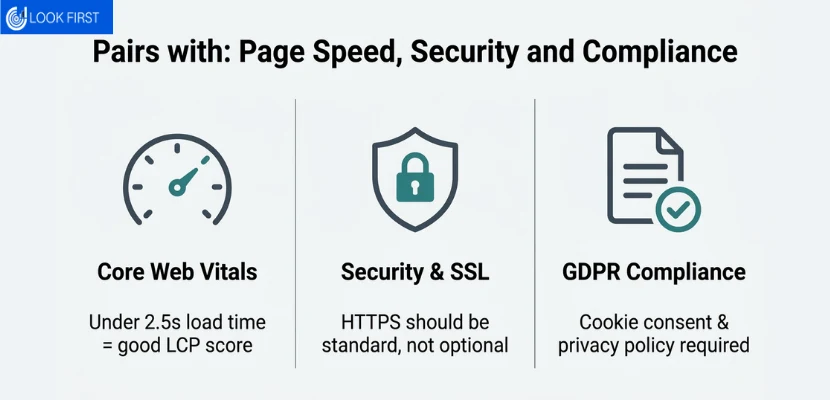
This section rarely gets a mention in most guides, yet it affects both user experience and your legal exposure as a business owner. A complete guide to web design goes into more depth on the technical side of this if you want the full picture beyond just the vetting questions.
Page Speed and Core Web Vitals
Google measures how quickly a page loads, how soon it becomes interactive, and how stable it is visually while loading. These measurements, known as Core Web Vitals, directly influence both user experience and search ranking.
Ask an agency how they test and optimise for this. A vague “we build fast sites” answer isn’t good enough. Ask to see a PageSpeed Insights score from a recent project instead.
Accessibility
Websites that are difficult to use for people with visual, motor, or cognitive impairments can exclude a meaningful part of your potential audience and increasingly carry legal risk. Ask whether the agency builds to WCAG accessibility standards as standard practice, or only when specifically asked.
GDPR and Data Handling
If your site collects any personal data through contact forms, bookings or newsletter sign-ups, UK GDPR rules apply. Ask how the agency handles cookie consent, data storage, and privacy policy requirements. The ICO’s guidance for organisations is a useful benchmark against which to check any answer.
SSL and Basic Security
Every modern website should run on HTTPS with a valid SSL certificate as standard, not as an add-on. Ask whether ongoing security monitoring and updates are included in any support package, particularly for CMS platforms like WordPress that require regular plugin updates to stay secure.
Red Flags To Watch Out For Before Hiring
Some warning signs are consistent across almost every bad agency experience:Before you sign, ask what happens if you want to end the contract partway through, and whether you keep the work completed so far. A confident agency will have a clear, fair answer ready rather than a vague shrug. Red flag What it usually means Vague timeline with no stages explained Poor project management, likely to slip deadlines Refuses to share past performance data May not track results, or results were poor CMS is locked or proprietary You’ll be stuck paying them for every small edit Testimonials only on their own site Reviews may be selectively curated or unverifiable Single lump-sum quote with no breakdown Hidden costs are likely to appear later No clear cancellation or exit clause in the contract You could be locked in even if the relationship isn’t working
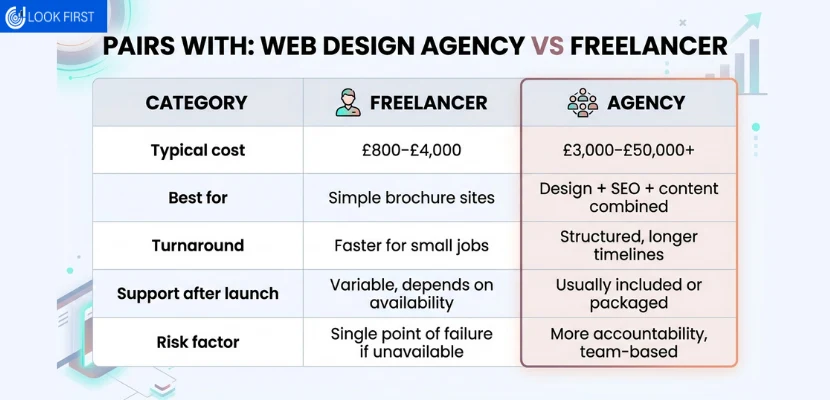
Web Design Agency vs Freelancer: Which Is Right for You?
Both have their place, depending on the size and complexity of the job.
A freelancer often makes sense when:
- Your budget is genuinely tight
- You need a simple brochure site with a handful of pages
- You already have a clear idea of what you want, with minimal strategy input needed
An agency tends to be the better fit when:
- You need design, SEO, and content working together as one strategy
- Ongoing support and scalability matter to you
- You want accountability if something goes wrong, since freelancers can be harder to reach if they move on to other work
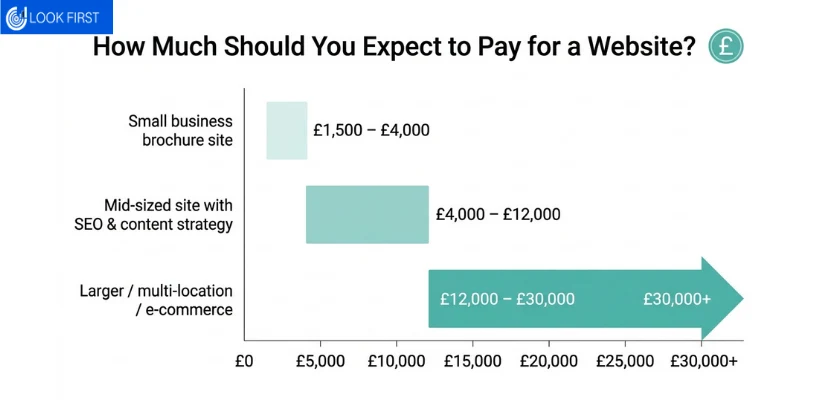
How Much Should You Expect To Pay?
Prices vary enormously depending on scope, but rough UK ranges for 2026 tend to look like this:
- Small business brochure site: roughly £1,500 to £4,000
- Mid-sized business with SEO and content strategy: roughly £4,000 to £12,000
- Larger, multi-location or e-commerce sites: £12,000 upwards
The cheapest quote is rarely the best value. A £600 website with no SEO foundation and a locked CMS often ends up costing more within eighteen months, once you factor in the rebuild.
For a much deeper breakdown of exactly what drives these numbers up or down, including platform choice, content, and ongoing costs, see our full guide on how much a website costs in London.
Choosing A Web Design Agency In London
London’s market has its own quirks worth factoring in.
Competition is fiercer in nearly every sector, which means SEO and content quality matter more, not less. A generic template site is far less likely to stand out against dozens of competitors targeting the same postcode. This is where a full-service digital marketing agency in London tends to have an edge over a designer working in isolation, since design decisions can be made with local competition and search behaviour in mind from the start.
It’s also worth asking whether the agency understands borough-level search behaviour. Someone searching “paving contractor Enfield” has a different intent from someone searching “paving contractor London”, and a good agency should build content that reflects that distinction rather than a single generic page trying to cover the whole city.
Meeting in person, even once, can also be worth the effort in London specifically, simply because the density of agencies means you have the option to be more selective. Look for web design and development services in London that are genuinely delivered by a local team, rather than outsourced offshore with a London contact number bolted on.
You can see how this plays out in practice in our case studies, including projects for trade and local service businesses across London boroughs.

Final Checklist Before You Sign
Before signing anything, run through this quickly:
- Do they have genuine experience in your industry?
- Is domain, hosting and CMS ownership clearly yours?
- Can you edit the site yourself without developer help?
- Have they explained their SEO and content approach in detail?
- Have they shown real performance data, not just a portfolio?
- Is the timeline and process clearly laid out?
- Is ongoing support included, or is it clearly priced separately?
- Is the quote broken down, with no vague lump sums?
- Have they addressed page speed, accessibility and GDPR compliance?
- Is there a clear, fair cancellation clause in the contract?
If you can tick most of these confidently, you’re in a strong position to move forward.
Conclusion
Hiring a web design agency is closer to starting a long-term relationship than making a one-off purchase. The site you launch is only the beginning. What happens over the following months and years, in terms of support, edits and search visibility, matters just as much as how the homepage looks on day one.
Asking these questions up front takes an extra 30 minutes during the sales process. It’s a small investment that can save you thousands in rework, lost rankings and frustration down the line.
Ready To Talk To An Agency That Answers These Questions Honestly?
If you’d rather skip the guesswork, book a free discovery call with Look First’s team. We’ll walk you through our process, show you real results from past clients, and answer every question on this list without the sales spin.
FAQS
Ask about their industry experience, who owns the domain and CMS after launch, how they approach SEO and content, whether they can show real performance data, their process and timeline, ongoing support after launch, and exactly what’s included in the price.
UK costs typically range from around £1,500 for a small brochure site to £4,000 to £12,000 for a mid-sized business site with SEO and content strategy. Larger or multi-location sites can cost £12,000 or more, depending on complexity.
Check independent reviews rather than only testimonials on their own site, ask for real Search Console data from past projects, and see whether they can explain their process clearly. Vague answers or reluctance to share results are warning signs.
Most agencies follow a similar structure: discovery and strategy, design, build and content population, testing, then launch and handover. Timelines vary by scope, but a good agency should give you a rough estimate for each stage upfront.
A small business website typically takes four to eight weeks from discovery to launch. Larger or more complex sites with custom features or extensive content can take three months or longer.