
Local SEO vs National SEO: Why London Businesses Need A Borough-Focused Strategy
London isn’t one market. It’s dozens of overlapping micro-markets stitched together, and a business in Ealing competes for very different attention than one in Stratford or Canary Wharf. Most businesses default to chasing broad, city-wide keywords without realising that borough-level targeting often wins faster, costs less, and brings in customers who are ready to buy. This guide breaks down when local SEO beats national SEO for a London business, and how to build a strategy around the boroughs that actually matter to you.
If you’re new to the basics, our local SEO guide covers the fundamentals in more depth.
Local SEO vs National SEO: A Quick Note
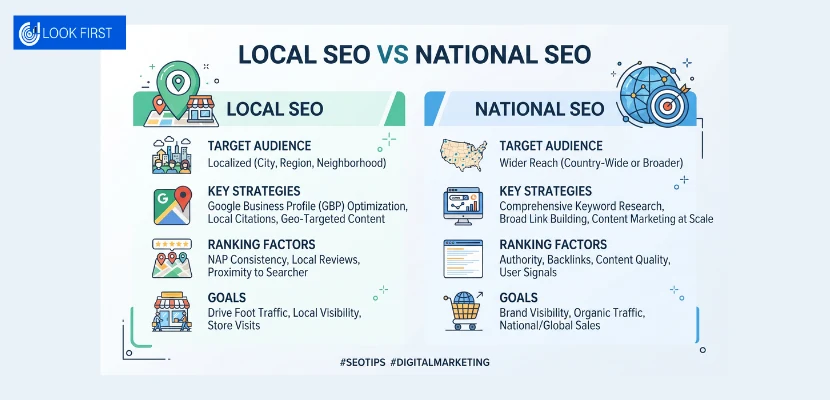
Local SEO targets people searching for something nearby, using location-specific terms like “plumber in Brent” or “digital marketing agency in Barnet.” National SEO targets broad, countrywide terms with no geographic qualifier, competing for visibility across the UK. Local SEO leans on Google Business Profile, local citations, and area-specific content.
National SEO leans on domain authority, backlinks, and content depth built at scale. For most London businesses serving a specific area or set of boroughs, local SEO delivers faster results and a better return.
Why "Digital Marketing Agency in London" Is Nearly Impossible to Rank For
Broad, city-wide terms put a small or mid-sized business up against national brands with years of domain authority and enormous content budgets. Trying to rank for “digital marketing agency London” means competing with every established agency in the capital at once. Borough-specific terms like “digital marketing agency in Ealing” face a fraction of that competition, while still capturing genuine local search intent.
This is why a borough-focused approach tends to outperform a single citywide push, especially for a newer or smaller business without years of built-up authority. Local ranking still comes down to relevance, distance, and prominence, which we break down further in our guide to Google Business Profile ranking factors.
Signs Your Business Needs a Borough-Focused Strategy
A borough-focused approach makes sense if your business:
- Serves a specific local area or a handful of boroughs rather than the whole of London
- Competes directly with other local businesses in search results and the map pack
- Relies on local footfall, calls, or bookings rather than nationwide online sales
- Sees customers search in ways that mention a neighbourhood, high street, or borough name
- Is newer or smaller, without the years of domain authority needed to compete nationally
If most of these apply, borough-level SEO is where your budget will work hardest.
London Borough Case Snapshots
The same local-versus-national logic plays out differently depending on the borough. In Ealing, businesses often lose out to central London competitors with bigger budgets. See our full breakdown in Digital Marketing in Ealing vs Central London.
In Wood Green, the challenge is less about ranking and more about earning trust once a shopper actually lands on the page. Our article on what makes a business trustworthy to Wood Green online shoppers covers this in detail.
In Edmonton, many small businesses still aren’t appearing in AI-generated search summaries. We cover this in Is Edmonton Invisible to AI Search?
Each borough has its own competitive landscape, but the underlying principle stays the same: a business that shows up specifically for its own area beats a business trying to be everywhere at once.
How to Build a Borough-Focused SEO Strategy
1. Build dedicated area pages, not one generic page
A single “we serve London” page rarely ranks well anywhere. Individual pages targeting each borough, each with genuinely unique content, perform far better. This is one of the fastest ways to build visibility across multiple boroughs without duplicating the whole site.
2. Keep your Google Business Profile accurate and complete
Google’s local ranking still comes down to relevance, distance, and prominence, and AI-generated local answers now pull directly from Google Business Profile data and reviews. Keeping a Google Business Profile accurate, with the correct service areas, categories, and regularly updated details, matters more than ever.
3. Fix your citations before anything else
Inconsistent business details across directories are one of the most common reasons a business fails to rank locally. Getting your name, address, and phone number consistent across the web is often the single fastest fix available. A business in Barnet or Ilford can move into the local map pack within weeks just by tidying this up.
4. Get genuine local reviews
Reviews that mention a borough by name feed directly into both traditional local rankings and AI-generated summaries. A steady flow of real reviews from customers in Brent, Greenwich, or Haringey does more for local visibility than almost any other single action.
5. Link your borough pages together
Internal links between your borough pages, blog content, and service pages help Google understand the full picture of where you operate. A borough page that links naturally to related areas nearby builds a stronger local footprint than isolated, unlinked pages sitting on their own. Browse the full list of London areas we cover to see how this looks in practice.
Local Business Signals Checklist
Local SEO in the Age of AI Search
Search has changed. AI Overviews now appear on a large share of Google searches, particularly for longer, question-style queries, the exact kind of search someone makes when deciding which local business to use. This shifts local SEO further towards clear, direct answers and structured, trustworthy content, not just keyword placement.
For a London business, this means the fundamentals still hold, but they matter even more. A complete Google Business Profile, consistent citations, genuine reviews, and content that answers real local questions directly are now feeding both traditional rankings and AI-generated summaries at the same time.
Conclusion
London rewards businesses that show up where their actual customers are searching, not just anywhere. A borough-focused strategy costs less to execute, faces less competition, and puts a business in front of people who are ready to act.
Whether you’re just getting started or rethinking a strategy that’s spread too thin across the whole of London, narrowing the focus to the boroughs that matter most is usually the fastest way to see real movement in rankings.
Want help building a borough-focused SEO strategy for your business?
Get a free consultation or a free SEO audit, no obligation.
Frequently Asked Questions
If your business serves a defined area or set of boroughs, yes. A single citywide page rarely ranks as well as individual pages built around each specific area, since it can’t compete on relevance the same way.
For most small and mid-sized businesses, a specific borough. Citywide terms put you up against national brands with far more authority, while borough-specific terms capture real local intent with much less competition.
It depends on capacity. A handful of well-built, genuinely unique borough pages will outperform a dozen thin, templated ones. Start with the areas closest to your existing customer base and expand once each page is performing.