
The Complete Digital Marketing Guide For London Businesses
Digital marketing is the umbrella term for all the strategies a business uses to promote itself online, from search engine optimisation and social media to website design, content, and email. For businesses based in London, digital marketing isn’t optional anymore. It’s the primary way customers find, research, and choose who they want to work with.
London is one of the most competitive markets in the world. Thousands of businesses are fighting for the attention of the same local audience. That audience is increasingly mobile-first, time-poor, and quick to judge a business based on its online presence alone. A strong website, a well-optimised Google Business Profile, and an active social media presence aren’t just “nice to have”; they’re often the deciding factor in whether a customer chooses you or a competitor two streets away.
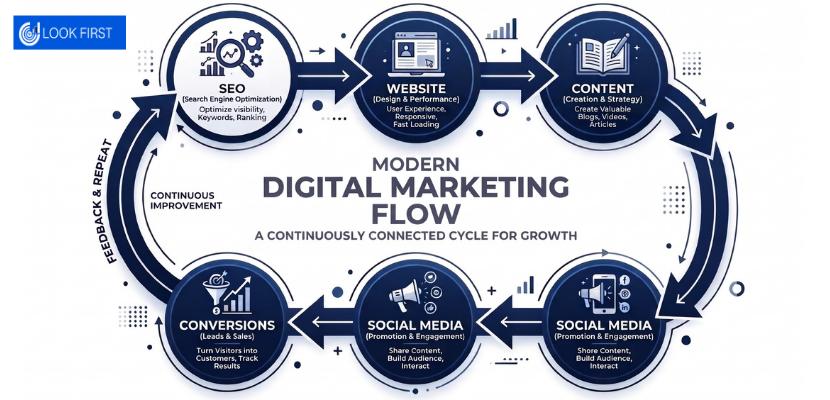
The challenge most London businesses face isn’t a lack of options; it’s knowing how all the pieces fit together. SEO drives organic traffic to your website. Your website needs to be designed to convert that traffic into leads. Social media builds brand awareness and keeps your audience engaged between purchases. Content marketing supports all of the above by giving search engines and customers a reason to keep coming back. None of these channels works well in isolation; the businesses that grow fastest are the ones that treat digital marketing as one connected system rather than a list of separate tasks.
This guide breaks down each part of that system in detail, so you understand not just what each channel does, but how they work together, and what it actually takes to get results as a business operating in London’s market. If you’re new to this space and want a clearer picture before diving in, it helps first to understand what a digital marketing agency actually does and how its work translates into real results for your business.
SEO Fundamentals: On-Page, Off-Page, Technical, Local & International
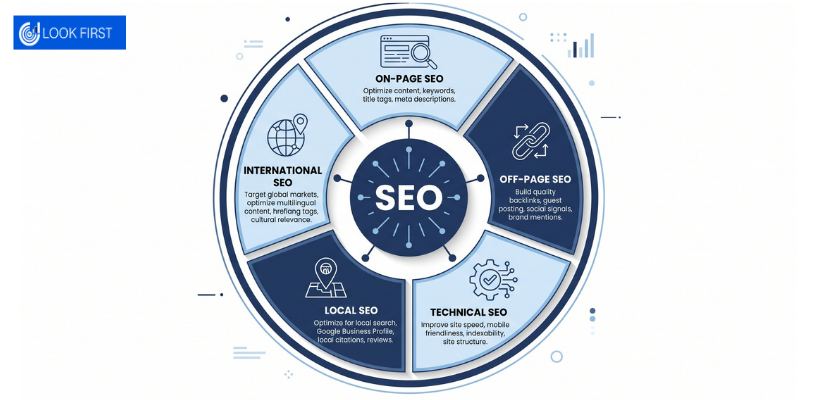
Search engine optimisation, or SEO, is the process of improving your website so it ranks higher in Google’s organic (non-paid) search results. Since most customers never scroll past the first page, ranking well for the right keywords is one of the highest-value investments a London business can make. SEO isn’t a single task; it’s made up of several interconnected types of SEO, each playing a different role.
On-page SEO
On-page SEO focuses on the content and structure of individual pages. This includes conducting keyword research to understand what your target audience is actually searching for, writing content that answers their questions thoroughly and demonstrates real E-E-A-T, and optimising elements such as title tags, meta descriptions, headings, and internal links. Good on-page SEO services ensure Google understands exactly what a page is about and that it genuinely deserves to rank.
Off-page SEO
Off-page SEO is everything that happens away from your website but still influences your rankings, most importantly, backlinks. When other reputable websites link back to yours, it signals to Google that your site is trustworthy and worth ranking higher. Digital PR, guest content, and local business directories all play a role in building this kind of authority over time.
Technical SEO
Technical SEO covers the behind-the-scenes factors that affect how well Google can crawl, index, and understand your website, site speed, mobile-friendliness, secure connections (HTTPS), structured data (schema markup), and a clean site architecture. A site can have great content and still struggle to rank if technical issues are getting in the way.
Local SEO
Local SEO is particularly important for London businesses serving specific areas or boroughs, helping you appear in the local map pack and “near me” searches. International SEO, on the other hand, matters for businesses targeting customers beyond the UK, using strategies like hreflang tags and country-specific content.
Each of these areas requires a different approach, but they all feed into the same goal: more qualified organic traffic, which is why SEO services in London need to cover all of them, not just one or two.
Website Design & Development As A Growth Foundation
Your website is often the first real interaction a potential customer has with your business. In many cases, it’s the deciding factor in whether they pick up the phone, fill out a form, or move on to a competitor. Website design and development services aren’t just about looking professional; it’s the foundation on which everything else in your digital marketing strategy is built.
A well-designed website needs to balance several things at once. It has to load quickly, since slow websites lose visitors within seconds and are penalised by Google’s ranking algorithms. It needs to be fully responsive, working seamlessly across desktop, tablet, and mobile. In London, where the majority of local searches happen on mobile devices, this isn’t optional. It needs clear navigation so visitors (and search engines) can easily find what they’re looking for. And critically, it needs to be built with conversion in mind, clear calls to action, easy-to-find contact information, and a layout that guides visitors toward booking, enquiring, or buying.
There’s also a direct relationship between website design and SEO. A site built on clean code, with proper heading structure, fast-loading images, and well-organised pages, gives your SEO efforts a much stronger foundation to build on. On the other hand, a poorly built website can actively work against your SEO; no amount of great content can fully compensate for a site that’s slow, hard to navigate, or broken on mobile.
For service-based businesses in particular, whether you’re a restaurant, a roofing company, or an e-commerce store, your website needs to reflect your industry and speak directly to the kind of customer you want to attract. Generic templates rarely perform as well as a site designed around your specific business and audience.
Social Media Marketing: Facebook, Instagram & TikTok
Social media marketing is about building a presence on the platforms where your target audience already spends their time, and using that presence to grow brand awareness, build community, and keep your business top of mind. If you want the full breakdown, our complete guide to social media marketing covers strategy in more depth. For London businesses, Facebook, Instagram, and TikTok each play a slightly different role.
Facebook remains one of the most effective platforms for local community engagement. Local groups, business pages, reviews, and event listings all help businesses connect with nearby customers, share updates, and build trust through genuine interaction.
Instagram is built around visual storytelling, making it especially valuable for businesses with a strong visual element, restaurants, design-led brands, and service businesses that can show before-and-after results. Consistent posting, engaging captions, and well-planned visuals all contribute to a stronger presence over time.
TikTok
TikTok has become one of the fastest-growing platforms for reaching younger, highly engaged audiences. Short-form, authentic video content tends to perform far better than overly polished, corporate-style posts, making it a great fit for businesses willing to show some personality.
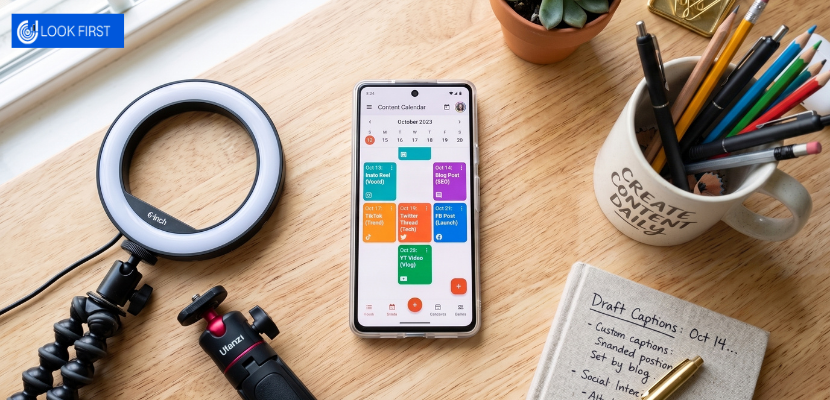
Across all three platforms, success comes down to consistency and planning. A well-structured content calendar ensures you’re posting regularly, mixing up content types, and aligning posts with key dates, promotions, or seasonal trends relevant to your business. Tracking engagement rate, likes, comments, shares, and saves relative to your audience size gives you a clearer picture of what’s actually resonating with your audience than follower count alone.
Social media marketing services in London also play an important supporting role in SEO and brand awareness. The more people interact with and share your content, the more visibility your brand gains, both on social platforms and indirectly in search.
| Platform | Best For | Content Style |
|---|---|---|
| Local community engagement | Groups, reviews, event listings | |
| Visual storytelling | Before/after, curated visuals | |
| TikTok | Younger, high engagement | Short-form, authentic video |
Local SEO & Google Business Profile Optimisation For London
For most London-based businesses, particularly those serving customers in a specific area or borough, local SEO is among the highest-impact digital marketing channels. When someone searches for “[your service] near me” or “[your service] in [area]”, Google typically shows a local pack: a set of three map-based results above the standard organic listings. Appearing in that local pack can dramatically increase calls, visits, and enquiries.
The foundation of local SEO is your Google Business Profile (formerly Google My Business). A complete, accurate, and regularly updated profile, with the correct business name, address, and phone number (commonly referred to as NAP), opening hours, photos, and service categories, gives Google the information it needs to match your business with relevant local searches. Consistency matters here: your NAP details should match exactly across your website, Google Business Profile, and any other directories or listings where your business appears.
Customer reviews play a major role, too. A steady flow of genuine, positive reviews not only builds trust with potential customers but is also a ranking factor Google considers when deciding which businesses to show in the local pack.
Beyond your Google Business Profile, local SEO Services also involve optimising your website, creating location-specific pages if you serve multiple areas, including your area name naturally in page content, and building local citations on relevant directories. For London businesses, this often means having dedicated pages for the different boroughs or neighbourhoods you serve, each written to reflect the specific area rather than duplicating content across pages.
Content Marketing & Blogging
Content marketing is the practice of creating useful, relevant content, articles, guides, case studies, and more that attract your target audience and support your wider SEO and social media efforts. Unlike one-off promotional posts, content marketing is a long-term strategy built around consistently publishing material that answers real questions your potential customers are searching for.
A well-planned content calendar is essential here. Rather than writing whatever comes to mind, effective content marketing maps out topics in advance, often organised around a central “pillar” topic (like this guide) with related “cluster” articles that go deeper into specific subtopics. This structure, sometimes called topic clustering, helps search engines understand the full breadth of your expertise on a subject, which can improve how your content ranks across the board.
Content marketing also compounds over time. A single blog post might only bring in a handful of visitors in its first month. Still, as it continues to rank for relevant searches, it can keep generating organic traffic for months or years, making it one of the most cost-effective long-term investments a business can make. It also gives you natural opportunities to earn backlinks, as other websites reference and link to genuinely useful content.
For service-based businesses, content marketing is particularly powerful when it’s tied to real customer questions, pricing, processes, common problems, and comparisons. The more thoroughly an article answers these questions, the more likely it is to become the resource people find, trust, and act on.
Conversion Rate Optimisation: Turning Traffic Into Leads
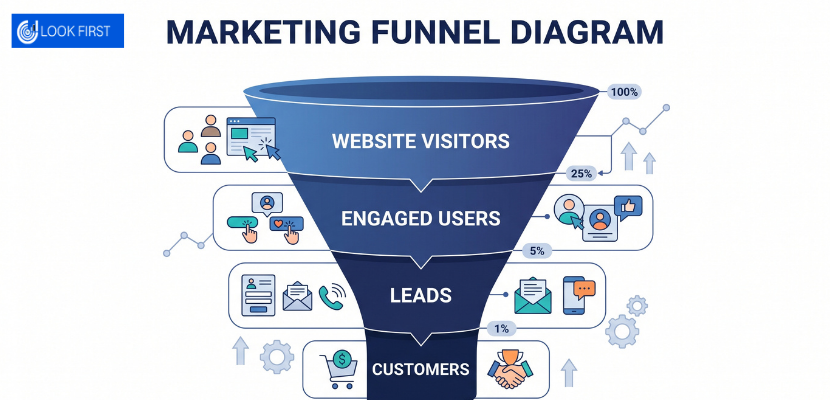
Driving traffic to your website is only half the equation. If visitors arrive and leave without taking any action, none of your other digital marketing efforts translates into actual business results. This is where conversion rate optimisation (CRO) comes in: the ongoing process of improving your website so a higher percentage of visitors take a meaningful action, whether that’s making an enquiry, booking an appointment, or completing a purchase.
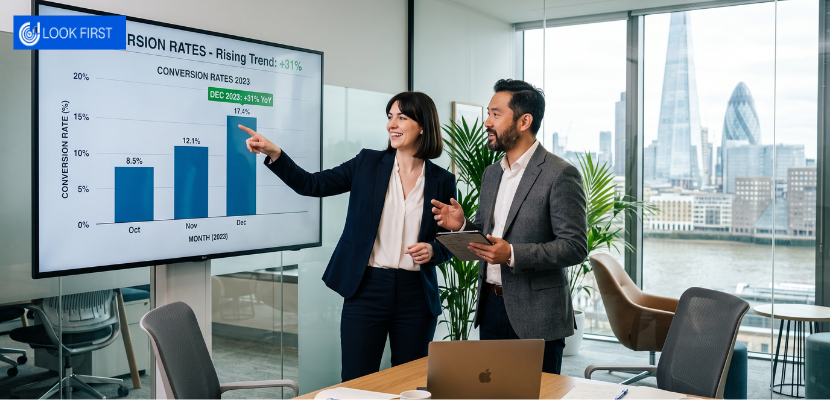
Your conversion rate, the percentage of visitors who complete a desired action, is one of the most important metrics in digital marketing, because it directly connects your traffic to real outcomes. A website that gets 1,000 visitors a month with a 1% conversion rate generates 10 leads. Improve that conversion rate to 3% without any additional traffic, and you’ve tripled your results.
CRO typically involves reviewing how visitors actually move through your site using analytics, identifying where they drop off, and testing changes such as clearer calls to action, simplified contact forms, more prominent trust signals like reviews or case studies, and faster-loading pages. Small, ongoing improvements often have a bigger long-term impact than a single redesign.
How Much Does Digital Marketing Cost In London?
One of the most common questions London businesses ask is simply: how much should I expect to pay? The honest answer is that it depends heavily on the scope of work, your industry’s competitiveness, and how quickly you want to see results. Still, there are some general patterns worth understanding.
SEO is typically priced as an ongoing monthly retainer rather than a one-off project, since it’s a long-term strategy that builds over time. Smaller, less competitive local markets generally cost less than targeting highly competitive industries or the citywide London market. Website design and development, on the other hand, is usually a one-off project cost (sometimes followed by smaller ongoing maintenance fees), with pricing varying significantly based on the site’s size and complexity.
Social media management services and content marketing are often priced based on the volume of content produced and the number of platforms managed. For example, managing three platforms with daily posting will cost more than managing one platform with a few posts per week.
Rather than focusing solely on the headline price, it’s worth considering digital marketing in terms of ROI. A higher monthly investment that generates a steady stream of qualified leads is often a far better value than a cheaper option that produces little measurable result. Asking any agency to explain exactly what’s included, how success will be measured, and what kind of timeline to expect is a reasonable and important part of the conversation.
| Service | Pricing Model | Typical Range Factors |
|---|---|---|
| SEO | Monthly retainer | Competitiveness of market, local vs citywide |
| Website Design & Dev | One-off project (+ maintenance) | Site size, complexity, features |
| Social Media Management | Per platform/volume | Number of platforms, posting frequency |
| Content Marketing | Per volume | Word count, articles per month |
How to Choose A Digital Marketing Agency In London
Choosing a digital marketing agency in London that genuinely understands your market, rather than one offering a copy-paste strategy, is one of the most important decisions a growing business can make. A few key factors can help separate genuinely effective partners from those who simply talk a good game.
Look for relevant experience
An agency that has worked with businesses in your industry, or with similar challenges, will understand your market faster and avoid common pitfalls. Case studies and real examples of past work are far more useful than generic claims.
Expect transparency
A good agency should be able to explain, in plain terms, what they’re doing and why, not hide behind jargon. You should know what’s included in your package, how your target audience is being defined, and how progress is being tracked.
Be realistic about timelines
SEO, in particular, takes time; meaningful improvements in organic traffic and rankings typically take several months, not days. Any agency promising overnight results for organic strategies should be approached with caution.
Check communication and reporting
Regular updates, clear reporting on key metrics, and responsiveness when you have questions are all signs of an agency that treats the relationship as a genuine partnership rather than a “set and forget” service.
Ultimately, the right agency for your London business takes the time to understand your goals, communicates clearly, and focuses on the metrics that actually matter to your bottom line, not just vanity numbers.
Measuring Success: Key Metrics & Analytics
Digital marketing without measurement is just guesswork. Fortunately, nearly every channel covered in this guide can be tracked, giving you a clear picture of what’s working and where to focus next.
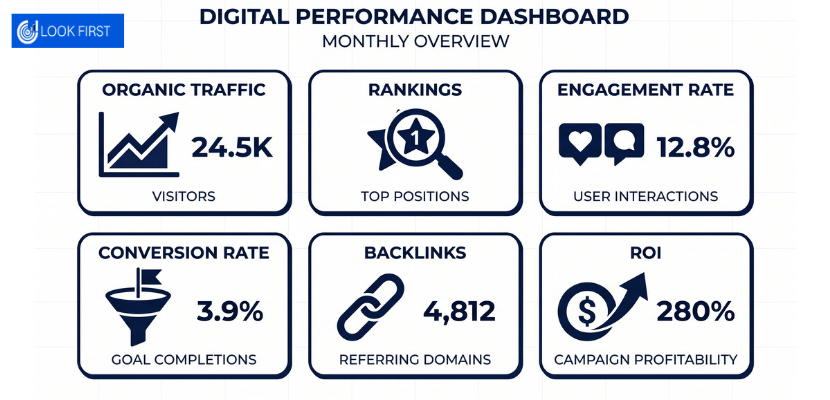
Organic traffic, the number of visitors arriving at your site through unpaid search results, is a core indicator of SEO performance over time. Alongside this, tracking your rankings for key search terms, including your visibility in the local pack, shows how your local SEO efforts are progressing.
Engagement rate on social media (likes, comments, shares, and saves relative to reach) tells you how well your content is resonating, separate from simple follower growth. Conversion rate ties everything together by showing how effectively your website turns visitors into leads or customers, arguably the metric that matters most, since it’s directly connected to revenue.
Backlinks, tracked over time, show how your site’s authority is growing, useful both for SEO and as a general indicator of brand awareness and digital PR success. And ultimately, ROI brings all of these metrics together, helping you understand the actual value generated relative to what’s being invested.
Tools like Google Analytics and Google Search Console provide most of this data for free, making regular reporting accessible even for smaller businesses. The key is consistency: reviewing these metrics regularly, rather than only occasionally, makes it far easier to spot trends, catch issues early, and make informed decisions about where to focus your efforts next. Getting these foundations right starts with choosing the right partner. Here’s a detailed guide to choosing the best digital marketing agency for your business.
Why Choose Look First For Digital Marketing Services
There’s no shortage of digital marketing agencies in London. What sets Look First Marketing apart is a combination of hands-on industry experience, transparent communication, and a genuine focus on results that move the needle for your business.
We’ve worked with restaurants, roofing companies, paving businesses, removal services, tyre shops, and e-commerce stores, which means we understand the specific challenges and customer behaviours of each industry, rather than applying a generic approach to every client.
Every strategy we build is tailored to your business goals, your target audience, and the competitive landscape of your specific market. We don’t chase vanity metrics; we focus on organic traffic growth, lead generation, and conversion rate improvements that translate into real revenue.
Our digital marketing services in London cover the full spectrum, from SEO and web design and development to social media marketing, AIO, and GEO services, so rather than managing three separate agencies for three separate channels, you have one team that understands how all the pieces fit together and keeps them aligned.
And if you want to see the kind of work we do before committing to anything, our case studies speak for themselves.
Book an appointment today, and let’s talk about what growth looks like for your business.
Conclusion:
Digital marketing in London isn’t a single strategy; it’s a system. SEO brings the right people to your website. Your website converts them into leads. Social media keeps your brand visible between searches. Content builds trust over time. Local SEO ensures the right customers find you in the right areas. When these channels work together, the results compound, and businesses that invest in getting the foundations right consistently outperform those chasing quick fixes.
Whether you’re a restaurant in Islington, a roofing company in Enfield, or an e-commerce store serving customers across London, the principles in this guide apply to you. Start with the channels most relevant to your business, track what’s working, and build from there.
If you’re not sure where to start, a free website audit is a good first step. It gives you a clear picture of where your current online presence stands and what’s worth prioritising first.
FAQS
Digital marketing refers to any marketing activity that takes place online, including SEO, social media marketing, content marketing, email marketing, and website design. For businesses, it’s the primary way to reach, engage, and convert customers in today’s market.
Costs vary widely depending on the services involved, the competitiveness of your industry, and the scope of work. SEO and social media are typically billed as ongoing monthly services, while website design is usually a one-off project cost. The right approach is to focus on the ROI a service generates rather than the price alone.
SEO is a long-term strategy. While some improvements (such as technical fixes) can have a quicker impact, meaningful growth in organic traffic and rankings typically takes several months of consistent work, particularly in competitive markets like London.
There’s no single “best” channel; the right mix depends on your industry, target audience, and goals. However, for most local businesses, a combination of local SEO, a well-designed website, and consistent social media presence forms a strong foundation.
It’s entirely possible to manage some digital marketing activities yourself, particularly social media posting or basic content creation. However, areas like technical SEO, website development, and ongoing strategy often benefit from specialist expertise, especially for businesses that don’t have the time to manage these consistently alongside running day-to-day operations.