
Will AI Tools Recommend Your Ealing Business Before Your Competitor’s?
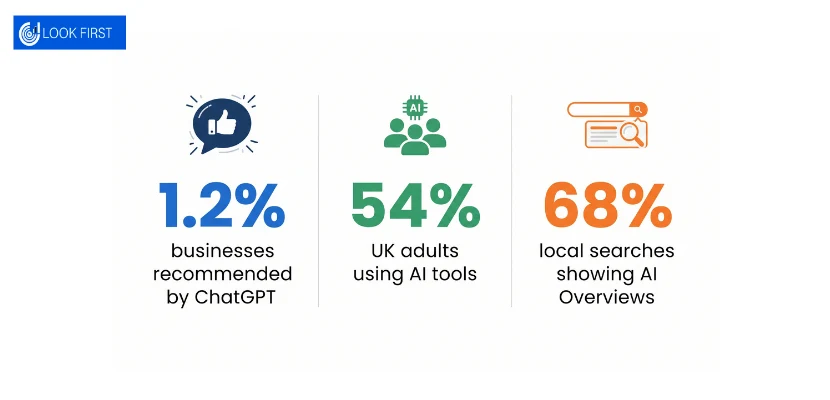
Right now, most local businesses lose this race without knowing it’s happening. A 2026 SOCi analysis of roughly 350,000 local business locations found ChatGPT recommended just 1.2% of them. AI tools like ChatGPT and Google’s AI Mode don’t read your website the way a customer scrolling Google does. They pull from a specific, narrow set of sources, and if you’re not represented there, you’re simply not in the running.
This isn’t a future problem. It’s already changed how people in Ealing look for a plumber, a dentist, or a café.
Why This Question Matters Right Now
More than half of UK adults (54%) now use AI tools like ChatGPT, Copilot, or Gemini, up from just 31% in 2024, according to Ofcom’s own research. That’s a genuine shift in behaviour, not a niche trend.
Google’s own AI Overviews now appear on up to 68% of local search queries, often sitting above the map pack customers used to scroll straight to. In many cases, that AI-written summary is the first thing a potential customer reads before they ever see a business listing.
For an Ealing business, this means the competition isn’t just the shop next door anymore. It’s whichever business the AI mentions first.
How AI Actually Decides Who To Recommend
This is where most business owners go wrong. They assume a good website and a decent Google ranking is enough. It isn’t, because AI tools are pulling from a different set of sources entirely.
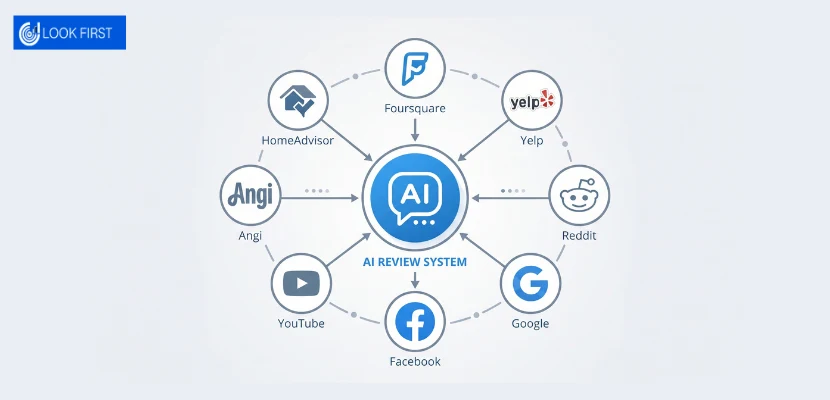
Independent testing on home-services businesses found AI recommendations lean heavily on a specific cluster of platforms: Yelp, Reddit, Google, Angi, HomeAdvisor, YouTube, Facebook, and industry “best of” lists. Your own website barely features in that mix. ChatGPT in particular relies heavily on Foursquare’s business data for local results, according to independent tests, so if your Foursquare or Bing Places listing is wrong or missing entirely, that’s a genuine blind spot.
Structured citations- your details on Google, Yelp, and Apple Maps, are table stakes now. What actually separates businesses AI recommends from ones it ignores is unstructured editorial mentions: a genuine write-up in local press, a mention on an industry “best of” list, a feature on a relevant community site. Recent local search research points to citation-related factors, especially this kind of editorial presence rather than directory listings, as among the strongest AI visibility signals.
What This Looks Like For An Ealing Business Specifically
Picture two similar businesses in Ealing offering the same service. One has a solid website, a well-kept Google Business Profile, and steady five-star reviews. The other has all of that too, plus a mention in a local Ealing news write-up, a spot on an “Ealing’s best” list somewhere, and an active, complete Foursquare listing.
When someone asks ChatGPT or Google’s AI Mode for a recommendation, the second business has a real structural advantage. Not because it’s necessarily better, but because it shows up in more of the places AI tools check before answering.
Where Most Ealing Businesses Are Losing This Race
A few gaps show up again and again, and none of them require a technical background to fix.
- No presence on Foursquare or Bing Places, despite these quietly feeding a large share of ChatGPT’s local answers
- Zero editorial mentions anywhere, no local press write-up, no “best of” list, nothing beyond directory listings
- A Google Business Profile that’s accurate but inactive, since most GBP impressions come from category searches like “plumber near Ealing” rather than searches for the business by name
- Content written for people, never for the specific question an AI tool is trying to answer, which is a gap our guide to what AIO actually involves covers in more depth
A Practical Starting Point
None of this needs a full rebuild. A few specific moves make the real difference.
- Claim and complete your Foursquare and Bing Places listings, since these quietly feed AI recommendations far more than most business owners realise
- Post something on your Google Business Profile weekly, even a short update, since consistency matters more here than polish
- Look for one genuine local mention you could realistically earn, a community write-up, a local “best of” feature, a mention on a relevant Ealing-focused site
- Ask an AI tool the exact question a customer would ask, and see honestly whether your business shows up at all
If you’re also weighing this against how your website competes locally, our piece on the SEO mistake costing Ealing businesses local customers covers the competitor side in detail.
Local SEO growth checklist
Tap each item as you complete it
Claim your Foursquare and Bing Places listing.
Post weekly on Google Business Profile.
Earn one genuine local mention.
Ask an AI tool the customer question.
0 of 4 complete
Conclusion
Being recommended by AI isn’t about having the best business on the street. It’s about existing, clearly and consistently, in the small set of places these tools actually check before they answer.
Most Ealing businesses haven’t looked at this yet, which means the ones who fix these gaps now have a genuine, if temporary, head start. Anyone running a digital marketing agency in Ealing sees this exact gap play out with new clients regularly.
If you want to know exactly where your business stands right now, a free audit from Look First Marketing will show you what’s actually holding you back.
Get My Free AuditFrequently Asked Questions
It depends on where your business is represented online. ChatGPT leans heavily on sources like Foursquare, Yelp, and editorial mentions rather than your website alone, so a business missing from these platforms is far less likely to be recommended, regardless of quality.
Ask ChatGPT or Google’s AI Mode the exact question a customer might ask, such as “best [service] near Ealing.” If your business doesn’t appear despite being a genuine local option, it’s likely missing from the specific sources these tools rely on.
No. AI tools pull local recommendations from a narrow set of third-party sources: Foursquare, Yelp, review platforms, and editorial mentions, far more than from business websites directly. A strong website still matters, but it isn’t the deciding factor here.
Start with your Foursquare and Bing Places listings, since these quietly feed a large share of AI-generated local answers. Posting regularly on Google Business Profile and earning even one genuine local editorial mention both help too.
Yes. Traditional Google rankings weigh your website and Google Business Profile heavily. AI recommendations weigh third-party citations and editorial mentions more heavily, which means a business can rank well on Google while still being invisible to AI tools.