
How Wood Green Businesses Can Compete With Brands in AI Search Results
Quick Answer
Independent Wood Green businesses don’t need a bigger marketing budget to compete with national chains in AI search. What they need is sharper, more specific information about what they do and who they serve locally, because that’s exactly what AI systems like ChatGPT, Perplexity and Google’s AI Overviews reward when someone asks for a recommendation.
Walk through Wood Green Shopping City on a Saturday afternoon, and the imbalance is obvious. Big-name retailers with recognisable logos sit metres away from independent shops that have been trading on the same stretch for years, sometimes longer than the chains next to them.
For a long time, that imbalance mattered less online than it does now. A shopper would search Google, click a few links, and often land on whichever business happened to answer their question best, big or small. AI search is changing that pattern again, and many independent business owners in Wood Green are understandably nervous about what it means for them.
The good news is that the fear doesn’t quite match the reality. Being smaller doesn’t put you at a disadvantage with AI search, contrary to what most people assume.
Why This Question Matters More In Wood Green Than Elsewhere
Wood Green independents compete more directly with chains than most local businesses because of Shopping City’s density of national retailers, metres from the high street. That constant side-by-side comparison makes AI search visibility a practical, live issue here rather than a hypothetical one.
Wood Green sits in an unusual position for a North London shopping district. It has genuine chain-store density thanks to the Shopping City complex, but it also has a thriving strip of independents along the high street and surrounding side streets.
That mix creates constant, direct competition in a way that a quieter residential area simply doesn’t experience. A customer standing outside the station with their phone out isn’t choosing between one shop and an abstract idea of “the market.” They’re often choosing between you and the chain three doors down, in real time.
This is also a fast-moving area. Footfall comes from destination shoppers, commuters passing through on the Piccadilly Line, and locals doing a regular weekly shop, all mixed together. AI tools increasingly sit at the centre of that decision-making, whether someone’s asking an assistant for a recommendation before they even leave the house or comparing options while they’re standing on the pavement. Trust plays a big part in that decision too, and we’ve looked separately at what makes a business trustworthy to Wood Green shoppers if you want that side of things covered in full.

The Assumption Most Independent Businesses Get Wrong
A bigger marketing budget does not guarantee better AI search visibility. General trust and local relevance are judged differently, and a small business can win the second even when a chain wins the first.
The most common worry we hear from smaller businesses goes something like this: “A big brand has a huge website, a marketing team, and years of history online. Surely AI just defaults to them.”
It’s an understandable assumption, but it misreads how these systems actually work. A large domain with plenty of backlinks tends to be trusted more easily by search engines and AI models in general. That’s real, and it’s not going away.
But trust, in a general sense, and its relevance to a specific local question are two entirely different things. When someone asks an AI assistant something like “is there a good independent [type of business] near Wood Green station,” a generic national page about a chain’s services often offers no useful information. It wasn’t written to answer that question. If the differences between how ChatGPT, AI Overviews, and traditional Google results actually work are still unclear, our GEO vs SEO vs AEO comparison breaks them down clearly.
Where Big Brands Actually Win In AI Search
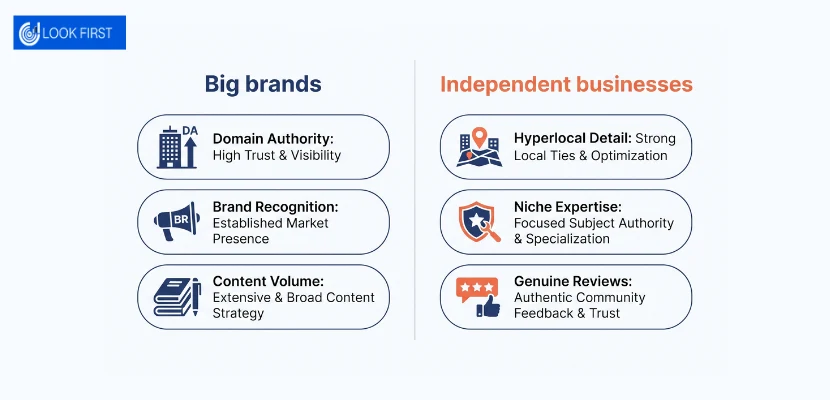
Big brands hold three genuine advantages in AI search: domain authority, brand recognition, and content volume. It’s worth being honest about this rather than pretending big brands have no advantages, because they do.
- Domain authority. Years of links, mentions, and citations build a level of general trust that’s genuinely hard to quickly match.
- Brand recognition as a shortcut. AI systems, much like people, sometimes lean on a familiar name as a safe default when the query itself is vague.
- Volume of content. Larger companies can produce far more pages, and more of them get indexed and cited somewhere across the web.
None of that should be dismissed. It’s just not the whole picture, and it’s not the part of the picture an independent Wood Green business needs to compete on. Our full guide to what AIO is and why businesses need it covers the technical side of this in more depth if you want to go beyond the strategic picture here.
Where Independent Wood Green Businesses Have The Real Advantage
Hyperlocal Specificity Chains Can’t Replicate
A national chain’s website almost never mentions Wood Green by name in any meaningful way. At best, it might list an address on a store locator page.
An independent business can write directly about the street it’s on, the bus routes nearby, the shopping centre entrance closest to its door, or the kind of customer it typically serves in that specific part of North London. That level of detail gives an AI system something concrete to work with when a question is genuinely local rather than generic.
Category And Niche Expertise
Chains tend to cover a broad range of products or services at a surface level, because that’s what scale requires. A specialist independent business can go far deeper on one thing.
If you’re the shop that’s spent fifteen years specifically fitting bespoke curtains, or the tradesperson known specifically for period property renovations in this part of Haringey, that specificity is a genuine content advantage. It’s much easier to write authoritative, detailed material about a narrow subject you know intimately than about forty product categories you stock.
Faster, More Genuine Review Velocity Relative To Size
A big chain might collect thousands of reviews nationally, but only a handful will mention Wood Green specifically, and most read as fairly generic. A smaller local business can build a smaller but far more locally concentrated set of reviews, often written in more specific, personal language.
That specificity matters more than the raw number for a local query. A handful of recent, detailed reviews mentioning your actual shop on your actual street are more useful to both customers and AI systems than a much larger pile of reviews about a national brand in general.
What Testing AI Search Queries For Wood Green Businesses Actually Shows
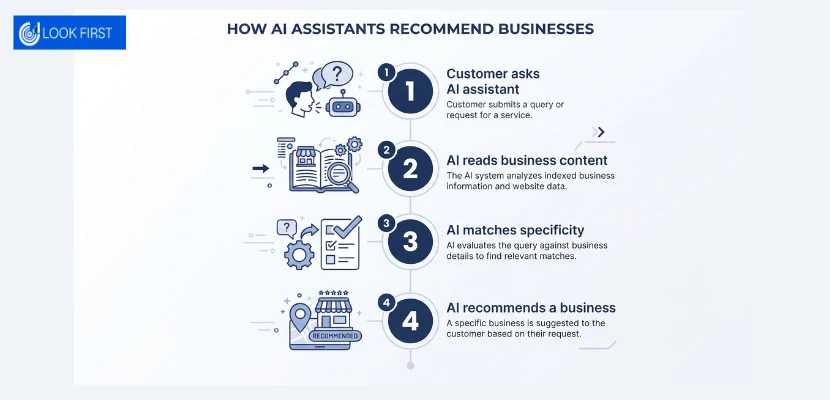
Broad queries tend to favour recognisable chain names, while specific, local queries favour well-documented independent businesses. The wording of the question determines which type of business an AI system surfaces.
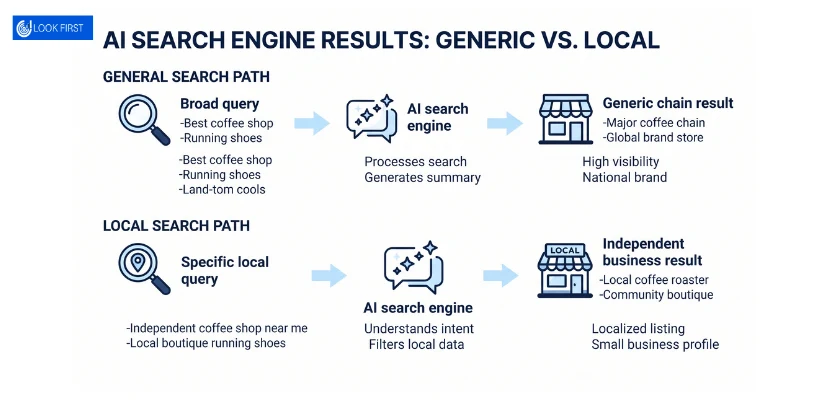
Ask an AI assistant a broad question like “best shops in Wood Green”, and you’ll often get a fairly generic answer, sometimes leaning towards the shopping centre itself or well-known national names, because the question itself is broad.
Ask something narrower, like “independent [specific category] business near Wood Green station” or “family-run [type of trade] in Wood Green,” and the pattern shifts. Specific, well-documented independent businesses start appearing far more readily, because the query gave the AI system a specific problem to solve rather than a vague one.
This is the pattern worth understanding. The more specific the customer’s question, the more an independent business’s specificity becomes an asset rather than a limitation. Google itself confirms there’s no secret trick to this beyond genuinely helpful content; its own guide on AI features and your website is worth reading directly rather than relying on secondhand summaries.
| Query type | Who tends to surface | Why |
|---|---|---|
| Broad, generic (“shops in Wood Green”) | Well-known names, shopping centre listings | Vague query defaults to recognisable, general answers |
| Specific, local (“independent [category] near Wood Green station”) | Independent businesses with detailed, local content | AI needs a precise match, not a general one |
| Niche expertise (“who specialises in [specific service] in Wood Green”) | Specialist independents | Depth of content beats breadth of brand |
A Practical Action Plan For Independent Wood Green Businesses
You don’t need a technical background to act on this. A few practical steps make the biggest difference.
Write For The Specific Question, Not The Generic One
Instead of a vague “we serve Wood Green and the surrounding area,” write content that answers the actual questions a local customer might type or ask aloud. Mention the streets, landmarks and neighbourhoods you genuinely serve, not a generic radius.
Claim The Hyperlocal Detail Big Brands Skip
Add specifics that a national competitor simply wouldn’t bother including: which bus stops are nearest, what’s changed on your street recently, which local landmarks you’re near. This is exactly the kind of detail AI systems use to distinguish one local option from another.
Go Deeper Where It Counts
If there’s one thing your business genuinely knows better than almost anyone else in Wood Green, build content around that specifically, rather than trying to cover everything at a surface level the way a bigger competitor would. Google’s own guide to optimising for generative AI features confirms there’s no special markup required for any of this, just genuinely helpful, well-structured content, which is exactly the specificity argument this article has been making.
What This Looks Like Long Term
Most independent Wood Green businesses haven’t started doing any of this yet, which means an early mover advantage is still genuinely available. That gap won’t stay open forever, but right now it’s wide open.
That’s genuinely good news if you’re reading this now, because it means the businesses that get specific, locally detailed content in place early have a real head start.
This isn’t a permanent advantage. As more businesses catch on, the bar will rise. But right now, in Wood Green specifically, there’s still plenty of room to become the obvious, specific answer to a local question before your competitors, big or small, get there first.
Scale will always give big brands certain advantages online. Specificity is the one advantage that scale genuinely struggles to buy.
Conclusion
Being smaller than the chains around you in Wood Green Shopping City isn’t the disadvantage in AI search that it might feel like. AI systems are ultimately trying to answer specific questions well, and specific, detailed, genuinely local content is often better produced by an independent business than by a national competitor with a hundred other locations to consider.
The businesses that will do best over the next couple of years won’t necessarily be the biggest. They’ll be the ones whose online presence gives an AI system and a real customer exactly the specific detail needed to make a confident choice.
If you’re not sure how visible your business currently is in AI search results, a free audit from Look First Marketing will show you exactly where you stand and what to prioritise first. You can also see how our digital marketing agency in Wood Green approaches this for local clients.
FAQS
Not inherently. AI tools favour whichever source answers a specific question most clearly. Big brands often win broad, generic queries, but specific, locally detailed independent businesses frequently perform just as well, or better, on narrower local questions.
Yes, particularly for specific, local queries. National chains rarely include the kind of street-level, hyperlocal detail that AI systems use to answer precise questions, which gives well-documented independent businesses a genuine opening.
Specificity. Independent businesses can write in detail about their exact location, niche expertise and genuine local reputation, while national chains typically publish broad, generic content that doesn’t answer precise local questions well.
Both, depending on how you respond. Ignoring it risks losing visibility to competitors who adapt first. Treated as an opportunity, it rewards the kind of detailed, genuine local knowledge many independent businesses already have but haven’t put online yet.
It builds on it rather than replacing it. Traditional local SEO fundamentals still matter; see our guide on local seo for the basics. This is about applying that same local specificity in a way AI systems can read and act on.