
Local SEO Ranking Factors In 2026: What Actually Moves the Needle
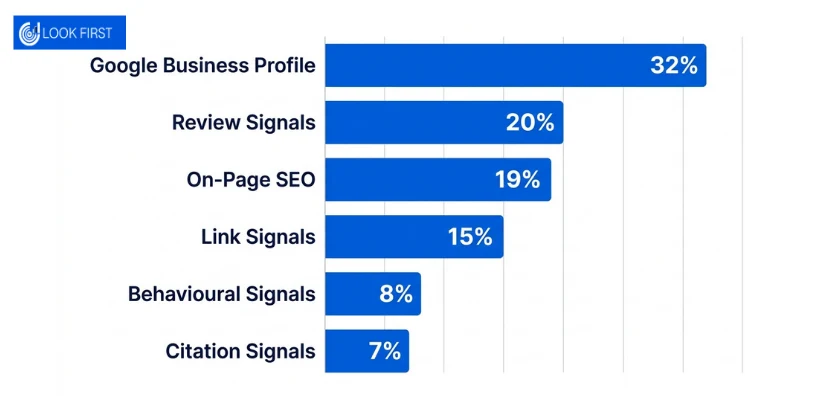
Local SEO ranking factors in 2026 are grouped into six weighted categories: Google Business Profile signals (32%), review signals (20%), on-page website signals (19%), link signals (15%), behavioural signals (8%), and citation signals (7%), according to Whitespark’s annual survey of 47 local SEO experts. Proximity to the searcher falls outside this breakdown entirely and typically outweighs all other factors combined, but it’s the one thing you can’t directly control.
That last point is the one worth sitting with. Of everything that determines your Local Pack ranking, only proximity is out of your hands. Every other factor above is a lever you can actually pull, and most businesses are pulling the wrong ones first.
Most local SEO guides list thirty-odd ranking factors, give each one a paragraph, and leave you no clearer on where to spend Monday morning. This one doesn’t do that. We’re going to walk through what’s actually weighted, what’s changed in 2026, what’s been quietly debunked by controlled testing, and where London businesses specifically need to focus. If you’re still getting your head around the basics first, our guide to what local SEO is and why London businesses need it covers the foundations.
Local SEO Ranking Factors: From Categories To Numbers
Relevance, distance, and prominence explain what Google is measuring. What that framework doesn’t tell you is how much each piece actually matters, and that’s the gap this article fills.
That gap matters because effort and impact aren’t evenly distributed. 2026’s survey of 47 local SEO experts didn’t just categorise the signals; it weighted them, and the weighting reveals something most local SEO advice glosses over: two categories account for over half of everything Google evaluates, while several others most agencies obsess over barely move the needle at all.
Here’s the actual breakdown, and what to do with it.
The 2026 Weighted Breakdown
Here’s how 2026’s survey of local SEO experts weights the controllable factors that determine Local Pack rankings:
| Signal Category | 2026 Weight | What It Covers |
|---|---|---|
| Google Business Profile | 32% | Primary category, completeness, business title, listing management |
| Review Signals | 20% | Volume, velocity, recency, star rating, response rate |
| On-Page SEO | 19% | Location pages, NAP on-site, schema, content relevance |
| Link Signals | 15% | Local backlink quality and relevance |
| Behavioural Signals | 8% | Click-through rate, calls, direction requests |
| Citation Signals | 7% | NAP consistency across directories |
Two things worth sitting with here. First, GBP and reviews together account for more ranking weight than on-page SEO, links, and citations combined, so if you’re splitting your effort evenly across all six categories, you’re almost certainly misallocating your time. Second, review signals have grown the fastest of any category, climbing from around 16% of local pack weight in 2023 to 20% today. That’s not a small shift for a three-year window.
Distance is worth a separate note, since it’s the one factor in this whole picture you can’t touch directly. You can’t move your business closer to every searcher. What you can do is widen your effective radius by being so relevant and so prominent on the controllable factors above that Google surfaces you for searches slightly further from your door than it would a weaker competitor.
Local organic results (the standard listings below the map) weight things differently. On-page signals carry noticeably more influence there, since there’s no map or profile competing for attention, just your website against everyone else’s.
Three Factors That Newly Entered The Top 10 In 2026
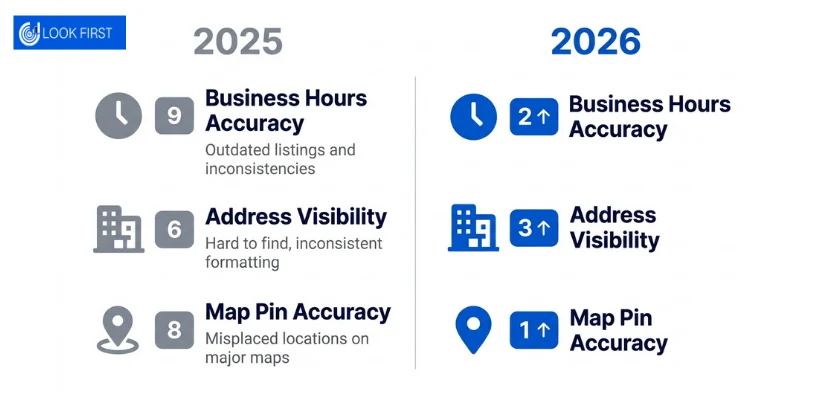
Google’s local algorithm doesn’t just reweight existing factors each year; it occasionally promotes entirely new ones. Three factors broke into the top 10 individual ranking signals for the first time in 2026:
Business hours accuracy at the moment of search
Rankings measurably degrade in the final hour a business is listed as open. If you offer after-hours or 24/7 service, listing your hours accurately isn’t just good practice; it’s now a genuine competitive advantage, since after-hours searches face far less competition.
Address visibility and formatting consistency
How your address is displayed and structured across your profile now carries more individual weight than in previous years.
Map pin accuracy
Google is placing growing importance on whether your pin sits exactly on your actual premises rather than approximately nearby.
None of these requires a strategy overhaul. They require an afternoon checking your profile against reality.
Myths That Have Been Tested And Debunked
Not every popular local SEO tactic earns its reputation. A controlled study by a local SEO firm tracked 441 keywords over nine weeks specifically to measure whether Google Business Profile posts influence ranking position. The result was zero measurable movement in ranking. Posts still have value; they boost click-through rate and customer engagement, but they don’t directly improve your position in the Local Pack.
Geotagging photos (embedding location data into image files before uploading) has been tested with similarly flat results. It doesn’t hurt, but it isn’t the ranking lever some agencies still sell it as.
The practical takeaway is that time spent on tactics like these is time not spent on the categories that actually carry weight: your GBP category accuracy, your review velocity, and your NAP consistency. If a tactic isn’t in the top four signal categories, treat it as maintenance rather than strategy.
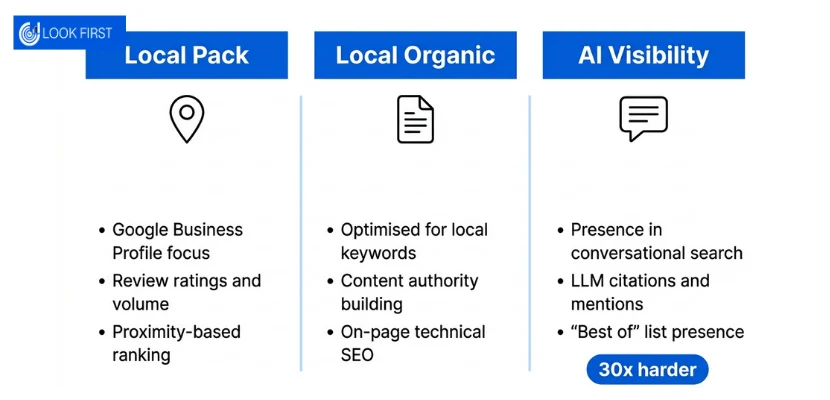
Local Pack vs Local Organic vs AI Visibility: Three Different Games
We’ve covered why AI search matters for London businesses elsewhere. What most guides get wrong isn’t whether AI visibility matters; it’s treating it as one more ranking factor to bolt onto the existing local SEO checklist. It isn’t. It’s a separate system, with separate weighting, and separate winners.
The gap between the two systems is bigger than most business owners assume. 2026’s Local Visibility Index found that achieving visibility in AI-generated local recommendations is roughly 30 times harder than ranking well in Google’s standard local results, and fewer than half of the businesses currently leading Google’s local search results also appear in AI recommendation tools. Contact details matched between Google Business Profiles and AI platforms like ChatGPT and Perplexity only about 68% of the time, which alone accounts for a meaningful share of that gap.
The signals that drive AI visibility aren’t the same as those that drive Local Pack visibility, either. Research points to the presence on expert-curated “best of” lists, dedicated individual pages for each service you offer, and prominence on industry-relevant domains as the strongest drivers of AI local search visibility, which is quite different from the GBP-heavy weighting that dominates the Local Pack.
Practically, this means a business investing purely in GBP optimisation may be winning one game while losing another entirely. If you want the fuller picture of how AI-driven search fits alongside traditional SEO, our guide to what AIO is and why businesses need it goes deeper on that shift.
Does The Weighting Change By Industry?
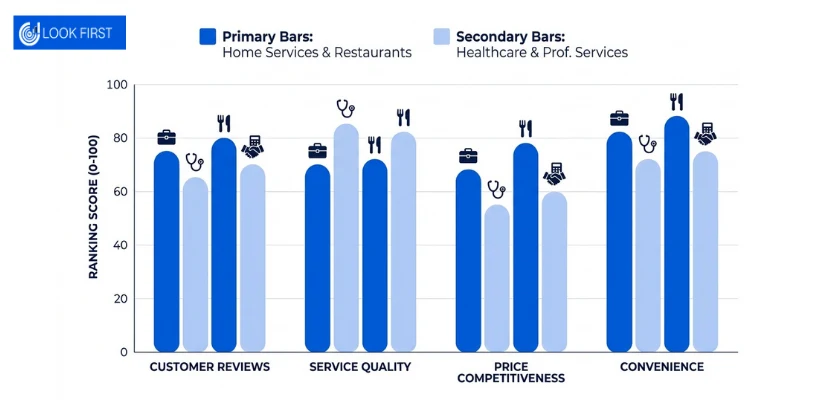
Yes, and by more than most business owners expect. The category-level weights above are averages across all industries, but the actual balance shifts noticeably depending on what you do.
- Home service businesses (plumbers, electricians, roofers) lean heavily on proximity, often accounting for over 40% of ranking decisions in this category, since customers overwhelmingly want the nearest available option.
- Healthcare and dental practices see review signals dominate more than almost any other category, sometimes accounting for around a third of ranking weight, reflecting how much trust matters before someone books an appointment.
- Restaurants tend to see a more even split between proximity and reviews, with neither factor dramatically outweighing the other.
- Legal and professional services lean more heavily on website authority and trust signals than the average business does, since these searches carry higher stakes and involve longer research phases.
If you’re running local SEO across multiple client verticals, this is worth internalising properly: the same six-category framework applies everywhere, but where you concentrate your limited hours should shift by industry.
What This Means For London Businesses Specifically
The weightings above are national averages, but London distorts them in one specific way: proximity’s 55% share carries more force here than almost anywhere else in the UK, simply because of density. A searcher in London typically has three, five, sometimes ten legitimate competitors within a mile, something a business in a market town never has to contend with. That density means the “controllable 45%” (GBP, reviews, on-page, links) has to work harder here just to offset the number of nearby alternatives Google can show instead of you.
The practical consequence is that borough-level content isn’t a nice-to-have; it’s what determines whether you’re even in the competitive set. A single generic service page can’t feed relevance signals for more than one small radius at a time, and in a market this dense, that radius is often the difference between page one and being fifteen listings down. This is exactly why local SEO services in London need to be built borough by borough rather than as a single citywide strategy; the density problem doesn’t respond to generic fixes.
Where To Spend Your Time First
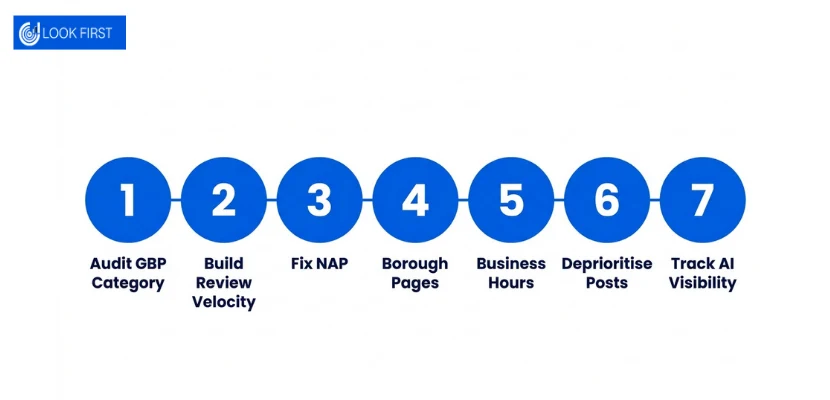
Given the weightings above, here’s a genuinely prioritised order, not a flat checklist:
1. Audit your GBP primary category first
It’s the single highest-weighted individual factor in the entire algorithm. Getting this wrong undermines everything else you do. See our full breakdown of Google Business Profile ranking for exactly how to optimise it.
2. Build review velocity, not just review count
A steady flow of new reviews outperforms a large stagnant total. Aim for consistency over spikes.
3. Fix NAP inconsistencies across directories
Low weight individually, but errors here quietly undermine trust in every other signal.
4. Build or refresh borough-specific location pages
If you’re a London business serving multiple areas. Generic city-wide pages are underperforming.
5. Check your business hours accuracy
Particularly if you offer after-hours or emergency service.
6. Deprioritise GBP posting frequency and geotagging as ranking tactics
Keep them for engagement value, not ranking value.
7. Separate your AI visibility
Strong Local Pack rankings don’t guarantee AI recommendation visibility, and the gap between the two is currently substantial.
Why Choose Look First Marketing For Local SEO
A lot of local SEO advice online is generic by necessity, written for a national or even global audience with no sense of how differently London boroughs behave as search markets. As local SEO specialists working across London, we build strategy around the actual weighting data above, prioritised for your specific industry and area, rather than a one-size-fits-all checklist.
If you want to know exactly where your business currently stands against these ranking factors, get in touch with Look First Marketing for a free local SEO audit. We’ll show you exactly how your business scores against the ranking factors that matter and what to prioritise first.
Conclusion
Local SEO in 2026 rewards prioritisation over volume. Proximity, GBP signals, and reviews account for the overwhelming majority of what determines your Local Pack position, while dozens of smaller tactics compete for a sliver of remaining influence.
The businesses winning right now aren’t doing more; they’re doing the small number of high-weight things properly, consistently, and with an honest understanding of which battle (Local Pack, local organic, or AI visibility) they’re actually fighting. Our complete SEO guide covers how local SEO fits into that wider picture.
FAQS
Proximity to the searcher accounts for roughly 55% of overall ranking decisions, but it isn’t controllable. Among the factors you can actually influence, Google Business Profile signals carry the most weight, accounting for around 32% of the Local Pack’s ranking influence.
A controlled study that tracked 441 keywords over nine weeks found no measurable ranking movement for GBP posts. They still support click-through rate and engagement, but they aren’t a direct ranking lever.
Not necessarily. 2026 research found that fewer than half of businesses that lead Google’s local search results also appear in AI recommendation tools like ChatGPT and Perplexity, since AI visibility is driven by different signals, “best of” list presence and dedicated service pages rather than GBP completeness.
Yes, on-page signals account for around 19% of Local Pack ranking weight and considerably more in local organic results, which sit below the map. See our guide to the different types of SEO for how on-page fits with the rest.
Citation weight has declined to around 7% of Local Pack ranking influence, but inconsistent NAP data across directories still actively undermines trust signals in other categories, so accuracy remains worth maintaining even as raw citation volume matters less.